
11
Sep
Installing a 500mm HDPE Water Main: Field Guide
Installing a 500 mm HDPE water main requires a confirmed pipe system, a controlled lifting plan, qualified butt-fusion work, engineered embedment, restrained appurtenances, and a polyethylene-specific commissioning procedure.
A 500 mm HDPE water main is normally supplied as straight pipe lengths that are fused into long, continuous strings before or beside the trench.
The installer must confirm that “500 mm” means metric outside diameter; it must not be treated as interchangeable with a nominal 20-inch IPS pipe.
Pipe SDR, pressure rating, material designation, fittings, valves, flange transitions and test pressure must all come from the approved design.
The pipe should be lifted with wide fabric slings, supported during fusion, lowered without impact and surrounded with suitable embedment placed to the specified density.
Successful installation depends on documented control at every stage, not on pipe flexibility alone.
Table of Contents
- Confirm the design basis
- Plan the site and installation sequence
- Receive, store and handle 500 mm pipe
- Control butt fusion and joint records
- Build the trench and embedment system
- Support valves, fittings and transitions
- Test, disinfect and commission the main
- Use a practical quality checklist
- Frequently asked questions
1. Confirm the 500 mm HDPE Water Main Design Basis
The first control point is dimensional terminology. In an ISO metric system, 500 mm usually identifies the pipe outside diameter. A 20-inch IPS system has a different outside diameter, so fittings, fusion equipment, flange adapters and valves must be ordered for the actual dimensional standard.
Do not select SDR from diameter alone. The designer must check operating pressure, surge or transient pressure, temperature, design life, water chemistry, external loads, burial conditions and the governing standard. For waterworks projects, AWWA C906 covers PE pressure pipe and fittings from 100 mm through 1,650 mm; ISO 4427 is commonly specified for PE water supply systems in metric markets.
| Item to confirm | Why it matters |
|---|---|
| Outside-diameter system | Prevents incompatible fittings and fusion equipment. |
| Material and product standard | Defines resin, dimensions, performance and marking requirements. |
| SDR or DR | Controls wall thickness and forms part of pressure design. |
| Operating and surge pressure | Determines whether the selected pressure class is adequate. |
| Joining and transition details | Coordinates fusion, flanges, valves and restraint. |
| Test and disinfection requirements | Avoids applying a rigid-pipe procedure to a viscoelastic PE system. |
For preliminary dimensional review, use the HDPE water pipe size chart, then confirm the final dimensions from the project standard and the manufacturer’s certified data.
2. Plan the Site and Installation Sequence
A 500 mm pipe string requires more working space than its diameter suggests. The method statement should identify the fusion area, pipe-string route, lifting points, crane or excavator access, trench crossings, groundwater controls, exclusion zones and contingency actions for weather or equipment failure.
Fusion is often completed beside the trench because a long string reduces the number of in-trench joints. The available corridor, bend geometry, traffic control and safe lifting capacity determine whether the main should be assembled as one string or several controlled sections.
Before excavation starts, locate existing utilities and approve the trench support system. Any change in alignment, depth, soil or groundwater that alters the design assumptions should be referred to the engineer rather than solved by field improvisation.
3. Receive, Store and Handle 500 mm HDPE Pipe
Check every delivery against the purchase specification: diameter, SDR, material designation, standard, production marking, quantity and physical condition. Quarantine pipe with deep gouges, flattened ends, contamination or handling damage until the manufacturer or engineer evaluates it.
Store straight lengths on level supports that prevent point loading and uncontrolled rolling. Separate incompatible products and protect machined or fusion surfaces from mud, oil and standing water.
Use wide, non-abrasive fabric slings and lifting equipment rated for the pipe string, fittings and rigging. Chains, wire ropes, hooks through the bore and dragging across sharp ground can damage the pipe surface. Nobody should stand beneath a suspended pipe.
4. Control Butt Fusion and Joint Records
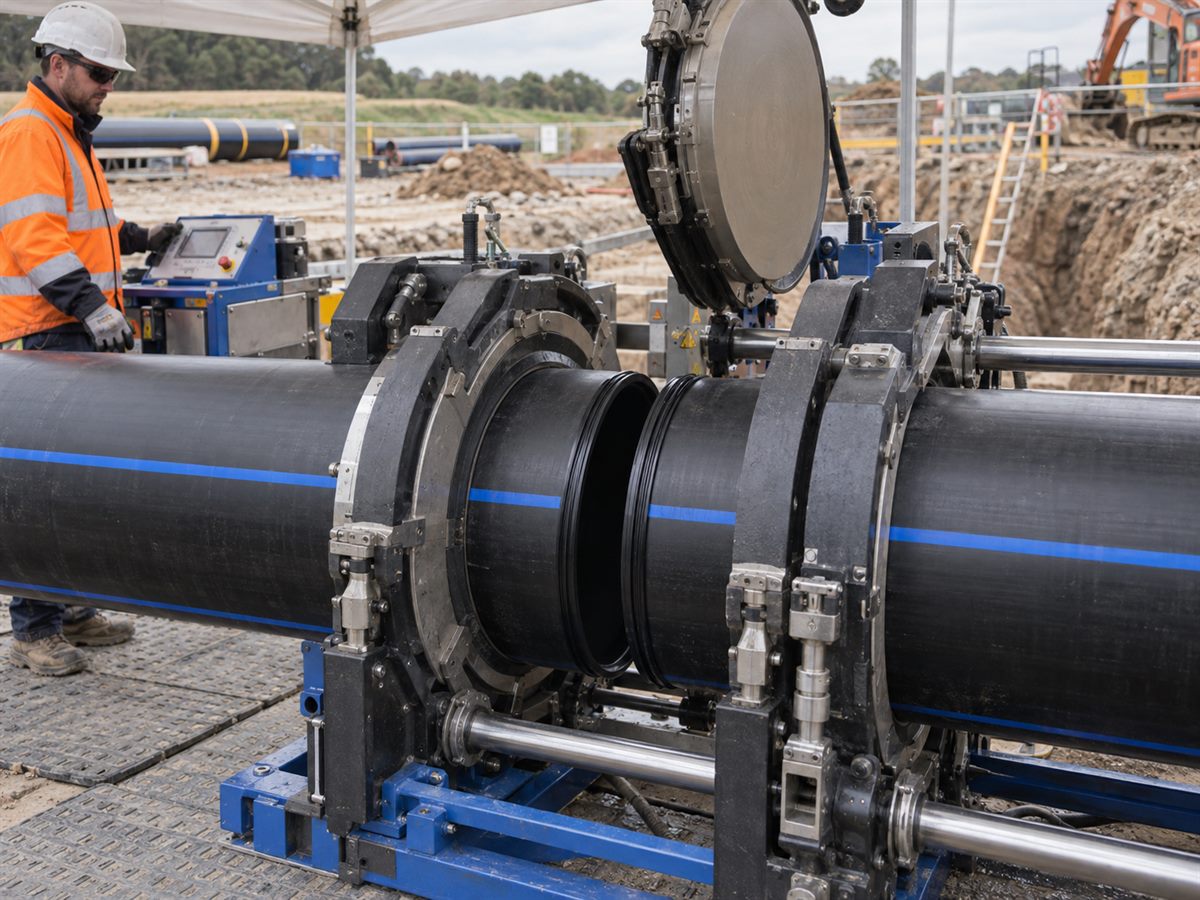
Butt fusion is the normal joining method for long 500 mm HDPE pipe strings when the pipe and fittings have compatible dimensions and polyethylene formulations. ASTM F2620 describes field heat-fusion practices, but the accepted procedure must match the pipe manufacturer, project specification and fusion machine.
The essential sequence is to secure and align the components, face the ends, verify alignment and cleanliness, heat both faces against the controlled heater plate, change over without contaminating the melt, apply the specified fusion pressure and hold the joint motionless through cooling.
Fusion parameters should never be copied from a different pipe size or guessed from appearance. The operator needs the approved time, temperature, interfacial pressure and cooling requirements, plus allowances required by the procedure for weather and equipment configuration.
Record operator identity, machine identification, pipe data, joint number, date, time and applicable fusion parameters. Inspect the bead and alignment after cooling, while recognizing that visual inspection does not replace compliance with the qualified procedure. For a separate explanation of the process, see how HDPE hot-plate butt fusion works.
5. Build the Trench and Embedment System
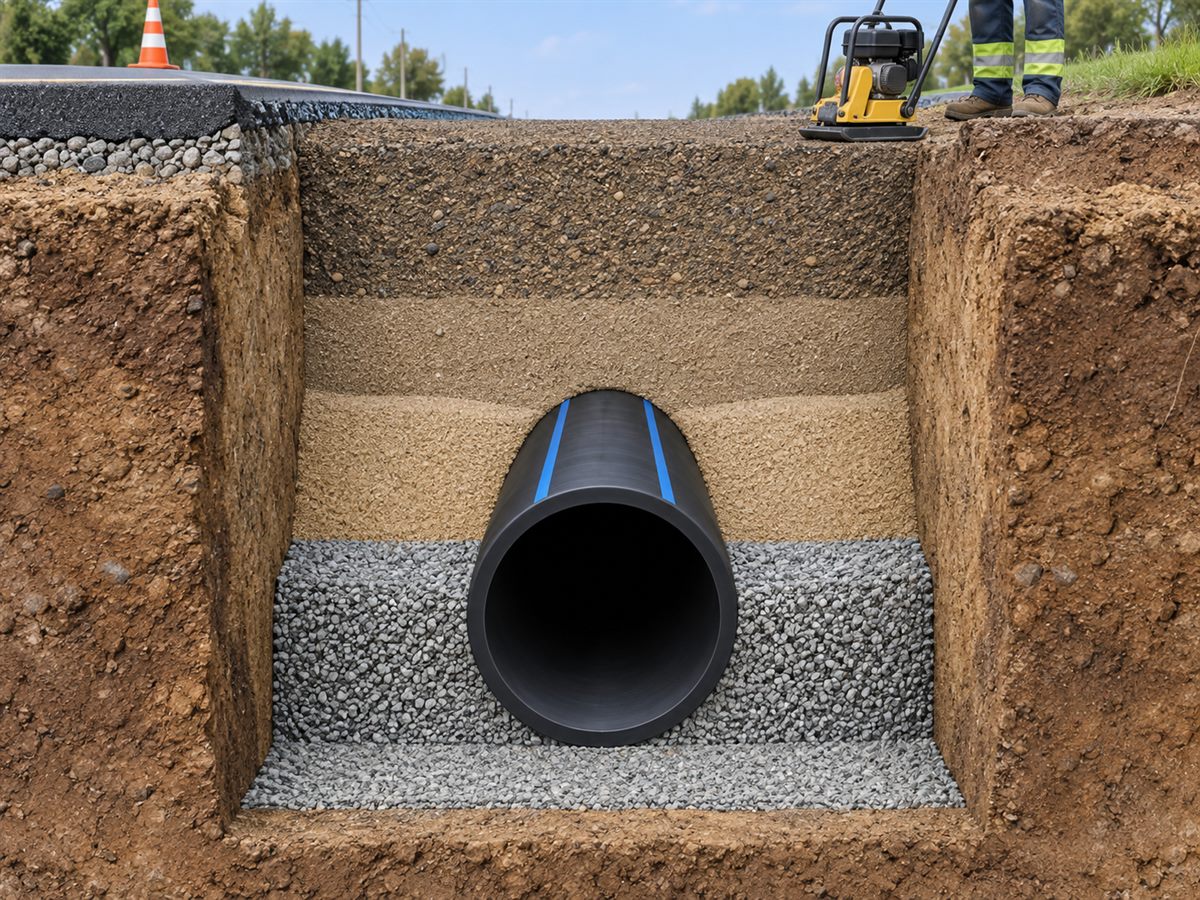
A buried HDPE water main performs as a pipe-soil system. Trench width, bedding, embedment material, groundwater control, placement lifts and compaction must therefore follow the approved design rather than a generic depth rule.
Prepare a continuous, uniform foundation and remove rocks, frozen material and other hard points that could create concentrated loading. When unstable native soil, groundwater or over-excavation is present, use the engineer’s specified stabilization or replacement detail.
Lower the fused string without impact, uncontrolled bending or contact with trench protection. Maintain the specified bend radius and do not force the pipe against structures to correct alignment.
Place embedment evenly on both sides and work material into the haunch zones without moving or damaging the pipe. Use equipment and lift thickness suitable for the selected material and required density; heavy compaction equipment should not operate directly over the pipe until the specified protective cover is in place.
The PPI Handbook Chapter 7 covers open-cut installation principles for solid-wall PE pressure pipe and emphasizes that procedures must be adjusted for site-specific and contractual conditions. More site-focused guidance is available in Puhui’s HDPE water pipe trench excavation and backfilling guide.
6. Support Valves, Fittings and Material Transitions
A fused PE pipeline can transmit longitudinal loads, but connected valves, hydrant assemblies, tees, flanged equipment and transitions may introduce weight, bending, thermal movement and thrust that the pipe should not be expected to carry alone.
Provide structural support, anchors or restraint exactly where the approved design requires them. Flange assemblies must use compatible adapters, backing rings, gaskets, bolt sizes and tightening procedures. Misalignment should be corrected before bolting; flange bolts must not be used to pull equipment into position.
Before ordering, coordinate the valve bore, flange standard, pressure class, bolt pattern and transition system with the 500 mm pipe dimensions. Review Puhui’s common HDPE pipe joining methods when the route includes connections other than butt fusion.
7. Test, Disinfect and Commission the Main
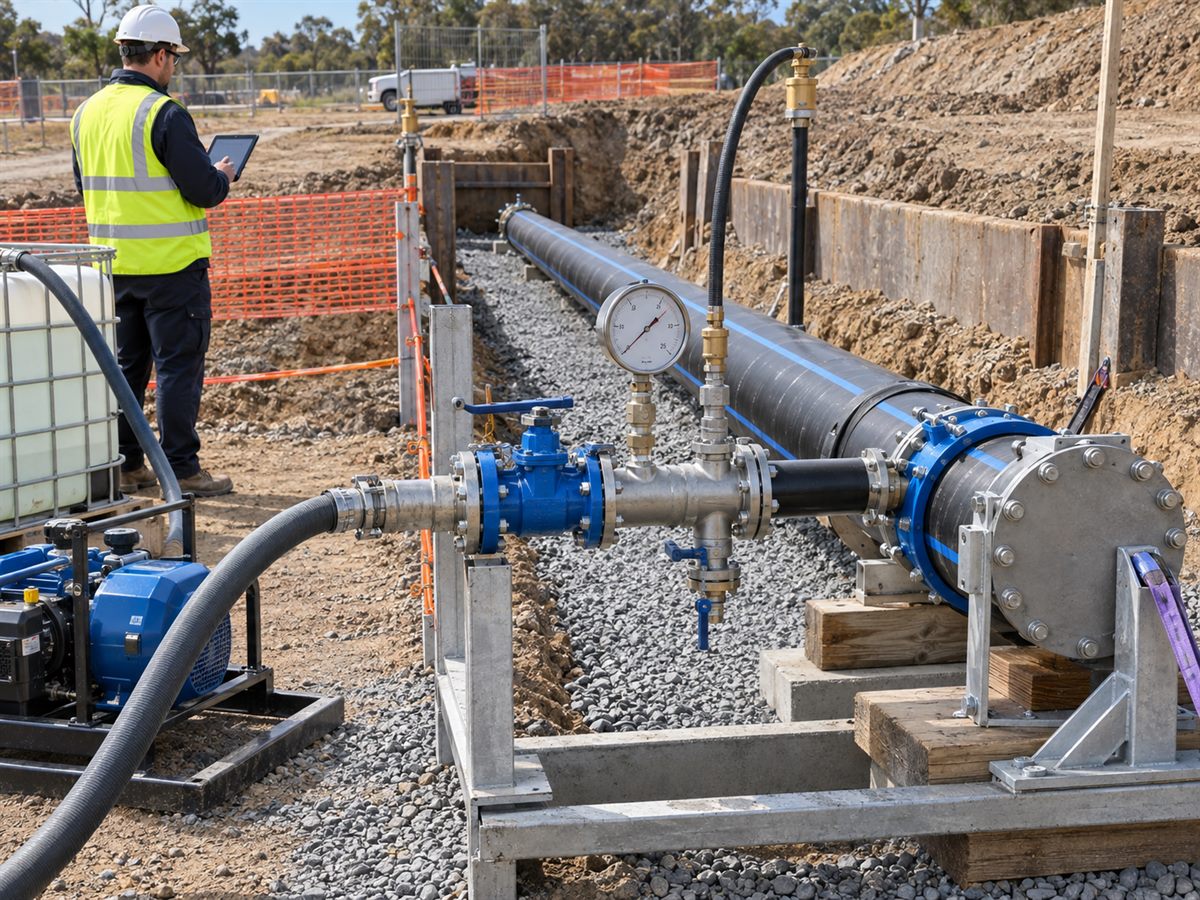
Complete the required backfill, restraints and appurtenance checks before pressurization. Isolate or protect components that are not rated for the test condition, restrain temporary closures, establish an exclusion zone and remove trapped air through planned high points.
HDPE expands under pressure, so initial make-up water and pressure change cannot be interpreted in the same way as a rigid pipe. ASTM F2164 addresses hydrostatic leak testing of polyethylene pressure piping and discusses effects that can influence restrained systems. Use the edition and acceptance criteria adopted by the contract, utility and authority having jurisdiction.
For potable-water service, flushing, disinfection, bacteriological sampling and release to service must follow the utility’s approved procedure; AWWA C651 is one commonly referenced standard for disinfecting water mains. Hydrostatic testing and disinfection are separate controls and neither proves that the other has been completed.
Use the project method statement rather than a universal test-pressure figure. The test pressure and duration must respect the pipe design, lowest-rated component, temperature conditions and local requirements. Puhui’s HDPE water pipe pressure-test overview provides additional introductory context.
8. Practical Installation and Procurement Checklist
- Confirm whether 500 mm is metric OD and record the governing dimensional standard.
- Approve the material designation, SDR, pressure class and surge basis.
- Match pipe, fittings, flange adapters and equipment before shipment.
- Verify lifting weights, sling locations, working radius and exclusion zones.
- Use qualified fusion operators, calibrated equipment and an approved procedure.
- Number and record every production joint.
- Approve trench foundation, bedding, embedment and compaction requirements.
- Support valves and rigid appurtenances independently where required.
- Approve the hydrostatic test, disinfection and sampling plan before filling.
- Close out as-built alignment, joint records, test results and material certificates.
For an accurate quotation, send the application, outside-diameter standard, SDR or pressure requirement, total length, straight-length preference, fittings schedule, required approvals, delivery destination and project timetable. The Puhui HDPE water pipe page can be used to start a product and document review.
9. Frequently Asked Questions
Is 500 mm HDPE pipe the same as 20-inch HDPE pipe?
No. A metric 500 mm OD pipe and a nominal 20-inch IPS pipe use different outside diameters. Confirm the dimensional standard before ordering pipe, fittings or fusion equipment.
Which SDR should be used for a 500 mm HDPE water main?
There is no universal SDR for this diameter. The designer must select it from operating pressure, surge, temperature, material, design life and applicable standard.
Can a 500 mm HDPE pipe string be lifted with chains?
Direct contact with chains or wire rope can damage the pipe. Use rated wide fabric slings and a lift plan appropriate to the string length and site conditions.
Does every butt-fusion bead need to be removed?
No. Bead removal depends on project requirements and service conditions; it should not be performed automatically or with methods that damage the pipe wall.
Why does HDPE require a specific hydrostatic test procedure?
Polyethylene is viscoelastic and expands under test pressure, so pressure and make-up water behavior differ from rigid piping. Apply the PE-specific procedure adopted by the project.
What documents should be retained at handover?
Retain approved material data, delivery records, joint logs, operator qualifications, calibration records, inspection results, as-built information, pressure-test reports and potable-water commissioning records where applicable.
Technical References
- ASTM F2620-24, Heat Fusion Joining of Polyethylene Pipe and Fittings
- ASTM F2164, Field Leak Testing of PE Pressure Piping Systems
- AWWA standards list, including C906 and C651
- PPI Handbook of Polyethylene Pipe, Chapter 7: Underground Installation