11
Sep
Deep Buried Sewer Pipe: HDPE vs PVC vs GRP vs Ductile Iron
A sewer buried more than 4 m deep can use HDPE, PVC, GRP, or ductile iron if the selected pipe system passes the project-specific structural, hydraulic, and installation checks. There is no technically valid rule that makes one material mandatory at 4 m. For a deep buried sewer pipe, the best choice depends on soil support, groundwater, external loads, settlement, joints, wastewater chemistry, and installed cost.
Quick selection answer
Start with HDPE where settlement, high groundwater, fused joints, or trenchless installation controls the design; consider PVC for controlled open-cut gravity sewers; evaluate GRP for large-diameter interceptors; and use ductile iron where concentrated loads, force-main pressure, restricted space, or numerous fittings justify its strength and weight.
This guide supports early engineering and procurement decisions. It does not replace a project-specific structural design completed under the governing local code.
Deep Buried Sewer Pipe: The Short Engineering Answer
For an ordinary gravity sewer installed by open cut at a depth of 4–8 m, HDPE and PVC are often the first materials evaluated because they combine corrosion resistance with relatively low handling weight.
HDPE usually gains an advantage where the alignment crosses soft ground, differential settlement is expected, groundwater is high, or fused joints and trenchless installation are important.
PVC can be the more economical solution where native soil is competent, the trench can be controlled, suitable granular embedment is available, and joint deflection remains within the permitted limit.
GRP is often competitive for large-diameter gravity interceptors because it provides a smooth bore, corrosion resistance, and relatively high ring stiffness at low weight. Its success depends on correct bedding, handling, and joint installation.
Ductile iron is frequently justified where a sewer faces concentrated loads, constrained corridors, force-main pressure, or a high number of fittings. Its internal lining and external protection must match the actual sewage and soil environment.
Why 4 m Is Not a Material Cutoff
Buried flexible pipes develop capacity through interaction with the surrounding soil. External loads cause the pipe to deflect, while properly compacted sidefill mobilizes soil resistance that limits further movement.
Both the Federal Highway Administration and the U.S. Bureau of Reclamation treat pipe stiffness and surrounding soil as connected design variables. A stiffer pipe cannot compensate for every installation defect, while properly designed embedment can substantially increase the capacity of a flexible pipe system. See the FHWA buried-pipe study and USBR M-25.
The design should evaluate:
- Total soil cover over the pipe crown
- Highway, railway, equipment, and construction surcharge loads
- Groundwater elevation and seasonal variation
- Native soil strength and compressibility
- Trench width and shoring-removal sequence
- Embedment material and achieved compaction
- Pipe diameter, wall profile, and long-term stiffness
- Allowable vertical deflection
- Empty-pipe external pressure and buckling resistance
- Differential settlement along the alignment
- Joint type and permitted angular deflection
- Effluent chemistry and operating temperature
The Plastics Pipe Institute does not treat 4 m as a universal HDPE limit. Its buried PE guidance still requires project-specific analysis whenever soil, groundwater, loading, or installation conditions fall outside simplified assumptions. See PPI General Buried Design.
Gravity Sewer or Force Main?
The first material-selection question is not burial depth; it is whether the pipeline operates as a gravity sewer or a pressurized force main.
A gravity sewer is normally governed by external load, deformation, groundwater infiltration, joint integrity, and the ability to maintain its required gradient.
A force main must also withstand internal pressure, surge, cyclic loading, vacuum conditions, and thrust at bends, tees, valves, and transitions.
HDPE and ductile iron are common force-main candidates because both can form restrained pressure systems when properly designed. PVC and GRP pressure pipe may also be suitable, but the specified product, joint class, and governing pressure standard must explicitly cover the operating and surge conditions.
A nonpressure sewer product must never be substituted into a force-main design merely because its diameter and nominal stiffness appear adequate.
HDPE vs PVC vs GRP vs Ductile Iron
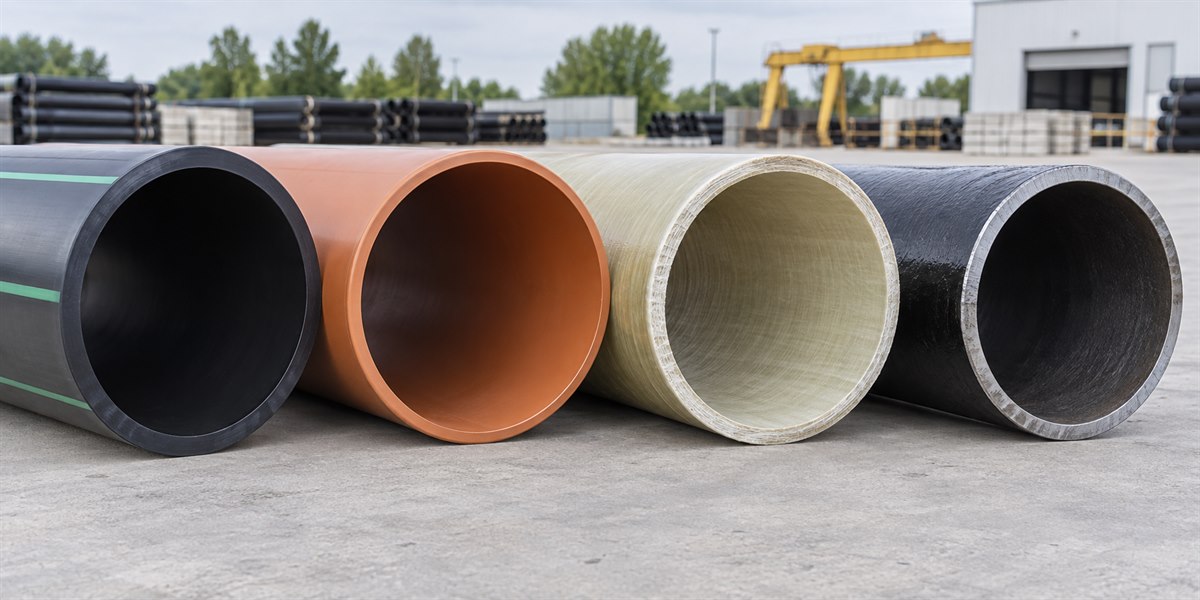
| Selection factor | HDPE | PVC-U | GRP | Ductile iron |
|---|---|---|---|---|
| Primary structural advantage | Flexibility, strain capacity, and fused joints | Consistent dimensions and useful initial stiffness | High stiffness-to-weight ratio for large diameters | High inherent wall and beam strength |
| Settlement tolerance | Generally high | Moderate; joint limits must be respected | Depends on pipe and coupling design | Strong barrel; joints and unsupported spans still require checks |
| Common joint options | Butt fusion, electrofusion, and mechanical joints | Gasketed bell-and-spigot joints | Gasketed couplings and project-specific restrained systems | Push-on, restrained, mechanical, and flanged joints |
| Principal installation risk | Unverified deflection, buckling, or grade control | Poor haunch support or excessive joint rotation | Point loading, handling damage, or uncontrolled bedding | Inadequate lining or external corrosion protection |
| Typical best fit | Settlement, groundwater, and trenchless work | Controlled open-cut gravity sewer | Large-diameter gravity interceptor | Concentrated loads, pressure, and complex fittings |
This comparison is a screening tool, not a replacement for structural calculations or verified manufacturer data.
When HDPE Is the Better Choice
HDPE is often the strongest candidate where a sewer alignment may experience differential settlement. Its strain capacity and fused joint system can accommodate movement that may overstress less flexible joint configurations.
Butt fusion can create a continuous, restrained pipeline and reduce the number of gasketed joints. Fusion quality still depends on qualified equipment, trained operators, verified parameters, and clean pipe ends.
HDPE is also widely used for horizontal directional drilling, sliplining, and other trenchless methods because continuous pipe strings can be pulled or inserted through the installation path.
For gravity sewers, designers must distinguish solid-wall pressure pipe from profile-wall gravity sewer pipe. SDR or DR identifies the dimensional ratio of many solid-wall products, whereas pipe stiffness or ring stiffness is commonly used for gravity sewer products. These values are not directly interchangeable.
A deep HDPE sewer requires checks for long-term vertical deflection, local wall strain, external-pressure buckling, groundwater flotation, construction loads, ovality, handling damage, joint quality, and grade retention.
PPI addresses deflection, buried buckling, deep fill, and groundwater flotation as separate design checks in its PE Pipe Handbook.
Detailed dimensions should be verified against the governing standard and certified manufacturer data. For preliminary reference, see the HDPE pipe specification and size table.
Connection procedures are intentionally isolated from this material-selection guide. They are explained in common HDPE pipe joining methods.
When PVC Is the Better Choice
PVC-U is frequently selected for gravity sewers where trench geometry is predictable, embedment can be properly placed, and the required size is available under the specified standard.
Its useful initial stiffness can simplify deformation control, but the installed pipe still depends on consistent haunch support and sidefill compaction.
PVC sewer systems commonly use gasketed bell-and-spigot joints. These joints can provide reliable watertight performance when the spigot is correctly inserted, the gasket is clean, and angular deflection remains within the manufacturer’s limit.
PVC is generally less tolerant of severe differential movement than a fully fused HDPE pipeline. Soft-ground transitions, manhole connections, and abrupt bedding changes therefore deserve special attention.
ASTM D3034-24e1 is one current specification covering PVC sewer pipe and fittings within its stated size and application range. The applicable regional standard must still be confirmed for each project. See ASTM D3034.
When GRP Is the Better Choice
GRP, also called fiberglass or glass-reinforced thermosetting resin pipe, is often competitive for large-diameter gravity interceptors.
Its smooth internal surface supports efficient hydraulic performance, while its low weight reduces lifting demands compared with many metallic alternatives.
GRP is not a single universal formulation. Chemical resistance depends on the resin system, liner, reinforcement, wall construction, and manufacturing quality. The supplier must confirm compatibility with the actual wastewater composition and temperature.
Deep installation requires control of pipe-zone compaction, joint alignment, angular deflection, and point loads. Coarse stones, uneven bedding, or uncontrolled shoring removal can create localized stresses that were not represented in the design.
Groundwater can move fine particles out of the embedment zone if filter compatibility is poor, gradually reducing side support. The Flowtite buried-pipe installation guide discusses soil groups, compaction, and groundwater-related migration controls.
ISO 23856:2021 is the current ISO system standard for qualifying GRP piping systems used in water supply, drainage, and sewerage applications within its scope. See ISO 23856.
A directly buried GRP pipe should not automatically be used for pipe jacking. Jacking pipe must be manufactured and verified for axial force, joint-face stress, steering load, and the chosen installation equipment.
When Ductile Iron Is the Better Choice
Ductile iron becomes attractive where the pipeline must tolerate high concentrated loads, restricted utility corridors, shallow-to-deep cover transitions, complex fittings, or pressurized operation.
Its strength can reduce deformation concerns, but it still requires continuous bedding and suitable sidefill. A strong pipe barrel should not be expected to bridge uncontrolled voids or severely yielding ground unless that condition has been explicitly designed.
For sewer applications, corrosion protection is a central selection criterion.
Hydrogen sulfide can develop in wastewater systems and may be biologically converted into sulfuric acid above the flow line. Standard cement-mortar lining may not be sufficient in a severe biogenic sulfuric acid environment, so a qualified special lining may be required.
Corrosive soil, stray current, dissimilar-metal connections, or aggressive groundwater may also require polyethylene encasement, coatings, cathodic protection, or another project-specific system.
ASTM A746 covers ductile iron gravity sewer pipe within its stated scope. See ASTM A746 and the DIPRA wastewater application guide.
Selection by Project Condition
| Project condition | Preferred starting point | Mandatory verification |
|---|---|---|
| Conventional 4–8 m gravity sewer in competent soil | PVC or HDPE | Deflection, buckling, embedment, and joint acceptance |
| Soft soil or differential settlement | HDPE | Grade control, long-term deformation, and flotation |
| Large-diameter gravity interceptor | GRP, profile-wall HDPE, or large-diameter PVC | Long-term stiffness, handling, joints, and availability |
| Force main with surge | HDPE or ductile iron | Surge, vacuum, fatigue, thrust, and valve operation |
| HDD or sliplining | HDPE | Pulling stress, bend radius, buckling, and bore geometry |
| Severe hydrogen-sulfide exposure | Qualified polymer, GRP liner, or specially lined ductile iron | Documented chemical compatibility |
A preferred starting point means the material deserves early evaluation; it does not make competing materials technically invalid.
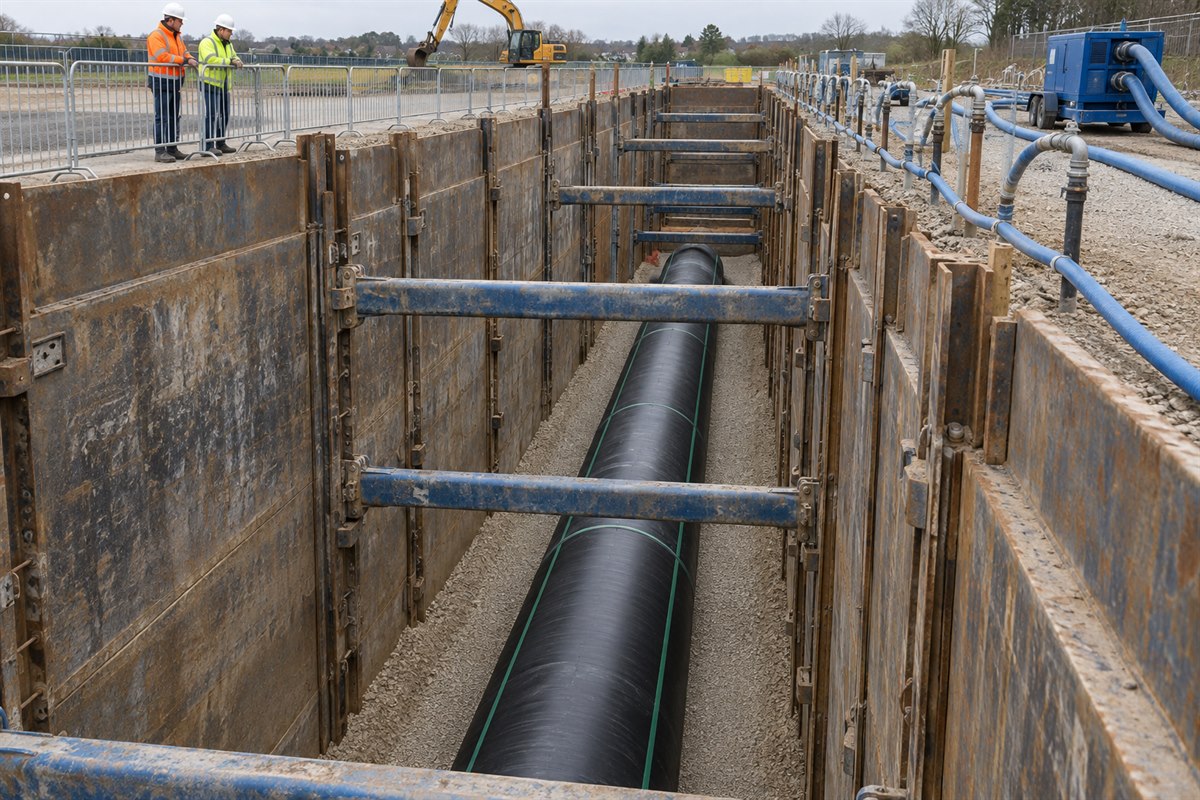
Minimum Design Inputs Before Selecting a Pipe
A supplier cannot provide a defensible deep-burial recommendation from diameter and cover depth alone.
| Required input | Why it matters |
|---|---|
| Gravity sewer or force main | Determines whether internal pressure and surge apply |
| Minimum and maximum cover | Establishes the earth-load range |
| Traffic and surcharge loads | Defines concentrated and transient loading |
| Groundwater elevation | Controls buoyancy, infiltration, and external pressure |
| Soil and embedment properties | Determines available side support |
| Trench width and shoring method | Changes load transfer and achievable compaction |
| Wastewater chemistry and temperature | Controls polymer, resin, and lining compatibility |
| Installation method | Separates open-cut, HDD, sliplining, and jacking requirements |
For a separate construction-focused explanation, see the underground HDPE pipe installation guide.
Common Deep-Sewer Specification Mistakes
Selecting material from burial depth alone
Depth establishes part of the load case but does not describe groundwater, soil stiffness, pipe diameter, trench construction, or operating pressure.
Assuming SN8 or SN16 determines allowable depth
Ring stiffness is one input to a buried-pipe calculation. The same stiffness class can produce different results in different soils, trench widths, and groundwater conditions.
Comparing SN directly with SDR or DR
SN, pipe stiffness, SDR, and DR describe different properties or dimensional relationships. A valid comparison must use the applicable test method, units, long-term properties, and structural model.
Checking the operating pipe but not the empty pipe
An empty pipeline under high groundwater may experience the most severe flotation or external-pressure condition.
Specifying pipe without specifying embedment
A flexible-pipe specification is incomplete if it omits bedding thickness, haunch placement, soil class, compaction target, lift thickness, and field verification.
Comparing purchase price instead of installed cost
At depths over 4 m, shoring, dewatering, excavation width, backfill, lifting equipment, installation rate, and worker protection can cost more than the pipe itself.
As one U.S. safety example, OSHA requires protective systems for many trenches at depths of 1.5 m or more, with additional engineering requirements for very deep excavations. Local rules must govern the actual project. See OSHA Trenching and Excavation Safety.
Relevant Standards and 2026 Updates
The following references were checked in September 2026 and should be verified again against the project location and specification date:
- ASTM D2321-26: underground installation of thermoplastic pipe for sewers and gravity-flow applications.
- ASTM D2412-26: external loading characteristics and pipe stiffness by parallel-plate loading. See ASTM D2412.
- ASTM F2947/F2947M-26: annular corrugated profile-wall polyethylene sanitary sewer pipe within its scope. See ASTM F2947/F2947M.
- ASTM D3034-24e1: PVC sewer pipe and fittings within its specified range.
- ASTM D3262-26: fiberglass sewer pipe within its stated scope. See ASTM D3262.
- ASTM A746-18(2022): ductile iron gravity sewer pipe.
- ISO 8772:2006: PE systems for nonpressure underground drainage and sewerage. See ISO 8772.
- ISO 4435:2003: PVC-U systems for nonpressure underground drainage and sewerage. See ISO 4435.
- ISO 23856:2021: GRP systems for water supply, drainage, and sewerage; it replaced the withdrawn ISO 10467.
- ISO 7186:2011: ductile iron products for sewerage applications; ISO identifies this edition as due for revision. See ISO 7186.
- ISO/FDIS 25780: the proposed replacement for ISO 25780:2011 covering GRP jacking systems was in final approval in 2026. See ISO/FDIS 25780.
A standard number alone is insufficient. The specification should state product class, diameter range, pressure or stiffness class, joint requirements, installation standard, and acceptance criteria.
Procurement and RFQ Checklist
Provide every bidder with the same technical inputs:
- Design standard and governing local code
- Gravity or pressure operation
- Nominal diameter and minimum internal diameter
- Full cover-depth profile
- Operating, surge, and vacuum pressure
- Groundwater level
- Native and imported soil properties
- Traffic and construction loads
- Trench and shoring arrangement
- Required stiffness, SDR, or DR class
- Allowable installed deflection
- Wastewater composition and temperature
- Joint type and leakage test
- Internal and external protection requirements
- Fittings, manhole, and structure connections
- Installation method
- Inspection and field-testing plan
- Required design life
- Manufacturer’s structural calculations
- Relevant third-party product certification
Quotations should be compared by installed system cost, not by price per metre alone. Buyers evaluating an HDPE option can also review the HDPE drainage and sewage pipe range before requesting project-specific calculations.
Final recommendation
Choose the pipe system that satisfies the calculated load cases, installation controls, chemical exposure, and lifecycle cost. A single burial-depth number cannot make that decision.
Frequently Asked Questions
Is 4 m too deep for HDPE sewer pipe?
No. HDPE can be installed substantially deeper than 4 m when the pipe, soil support, groundwater condition, and construction loads have been properly designed.
Is SN8 pipe automatically suitable at a depth of 4 m?
No. SN8 describes ring stiffness, not universal burial capacity. Diameter, soil, groundwater, live load, embedment, and allowable deformation must also be evaluated.
Which pipe is cheapest for a deep sewer?
The answer depends on installed cost. A lower-priced pipe may require more expensive bedding, shoring, dewatering, lifting, or joint work.
Which material is best under high groundwater?
Fused HDPE is often attractive because it can reduce the number of gasketed joints, but it must still pass flotation and external-pressure buckling checks. PVC and GRP can also be used with suitable joints and structural design.
Can GRP be used for deep sewers?
Yes. GRP can serve large-diameter buried sewers when its ring stiffness, long-term behavior, joint system, bedding, and chemical-resistance system are properly specified.
Does ductile iron require a special lining for sewage?
Not in every sewer, but wastewater capable of generating severe hydrogen-sulfide corrosion may require a lining specifically qualified for that exposure.
Can a gravity sewer pipe be used for a force main?
Not automatically. A force main requires a pipe and joint system rated for operating pressure, surge, vacuum, fatigue, and thrust conditions.
Can HDPE SDR and PVC or GRP SN classes be compared directly?
No. They are based on different dimensional or stiffness concepts and should be compared through project-specific calculations using the applicable standards and long-term properties.