10
Sep
How Does HDPE Hot Plate Butt Fusion Work?
HDPE hot plate butt fusion works by heating two prepared polyethylene pipe ends and joining their molten faces under controlled force.
The heater plate creates a uniform melt layer across each clean, square pipe end.
After the heater is removed, the softened faces are brought together before excessive heat is lost.
Polyethylene chains from both surfaces then move across the interface and become physically entangled.
Controlled cooling allows this interdiffused region to solidify into a continuous HDPE fusion joint.
No glue, solvent, sealing gasket, or separate coupling is needed between the two pipe ends.
Table of Contents
- What Is HDPE Hot Plate Butt Fusion?
- What Does the Heater Plate Do to HDPE?
- How Do Two Melted HDPE Ends Become One Joint?
- What Role Does Fusion Pressure Play?
- The Four Variables That Control Butt Fusion
- Why Does Butt Fusion Produce Beads?
- Why Must the Joint Cool Under Pressure?
- What Can Prevent Complete Molecular Fusion?
- How Is Butt Fusion Joint Quality Verified?
- When Is Butt Fusion the Appropriate Joining Method?
- Applicable Standards and Technical References
- What Buyers Should Confirm Before a Project
- Frequently Asked Questions
What Is HDPE Hot Plate Butt Fusion?
HDPE hot plate butt fusion—also called polyethylene butt fusion, mirror welding, or heater-plate welding—is a heat-fusion process used to join compatible PE pipes and fittings end to end.
The process normally includes clamping and aligning the components, facing their ends, heating both faces, removing the heater, joining the molten surfaces, and holding the assembly until it has cooled sufficiently. These actions belong to one controlled fusion cycle rather than a collection of independent steps.
Unlike a mechanical connection, the completed butt-fusion joint does not depend on bolts, elastomeric seals, threads, or a separate fitting positioned between the pipe ends. The objective is to form a continuous polyethylene load path through the pipe wall.
This article concentrates on why the process works inside the polyethylene. Readers who need an operating sequence can continue to the HDPE pipe butt fusion joining procedure.
What Does the Heater Plate Do to HDPE?
HDPE is a semicrystalline thermoplastic. Its internal structure contains ordered crystalline regions together with less ordered molecular regions. When a prepared pipe end contacts a temperature-controlled heater plate, heat conducts into the pipe wall and creates a controlled melt-flow zone near the surface.
As the interfacial temperature rises, the crystalline structure in this zone melts and the mobility of the long polyethylene molecules increases. The surface changes from a dimensionally stable solid into a viscous polymer layer capable of flowing and bonding to another compatible molten PE surface.
The heater is therefore doing more than making the pipe end “soft.” It must supply enough energy, for enough time, to establish a suitable temperature profile through the required fusion depth. Heating only the visible skin can leave the underlying material too cool for adequate molecular movement.
The plate face must also transfer heat evenly without introducing contamination. Fusion heaters consequently use clean, controlled surfaces, often with a non-stick coating. A dirty or damaged heater face can disturb heat transfer or deposit foreign material at the future joint interface.
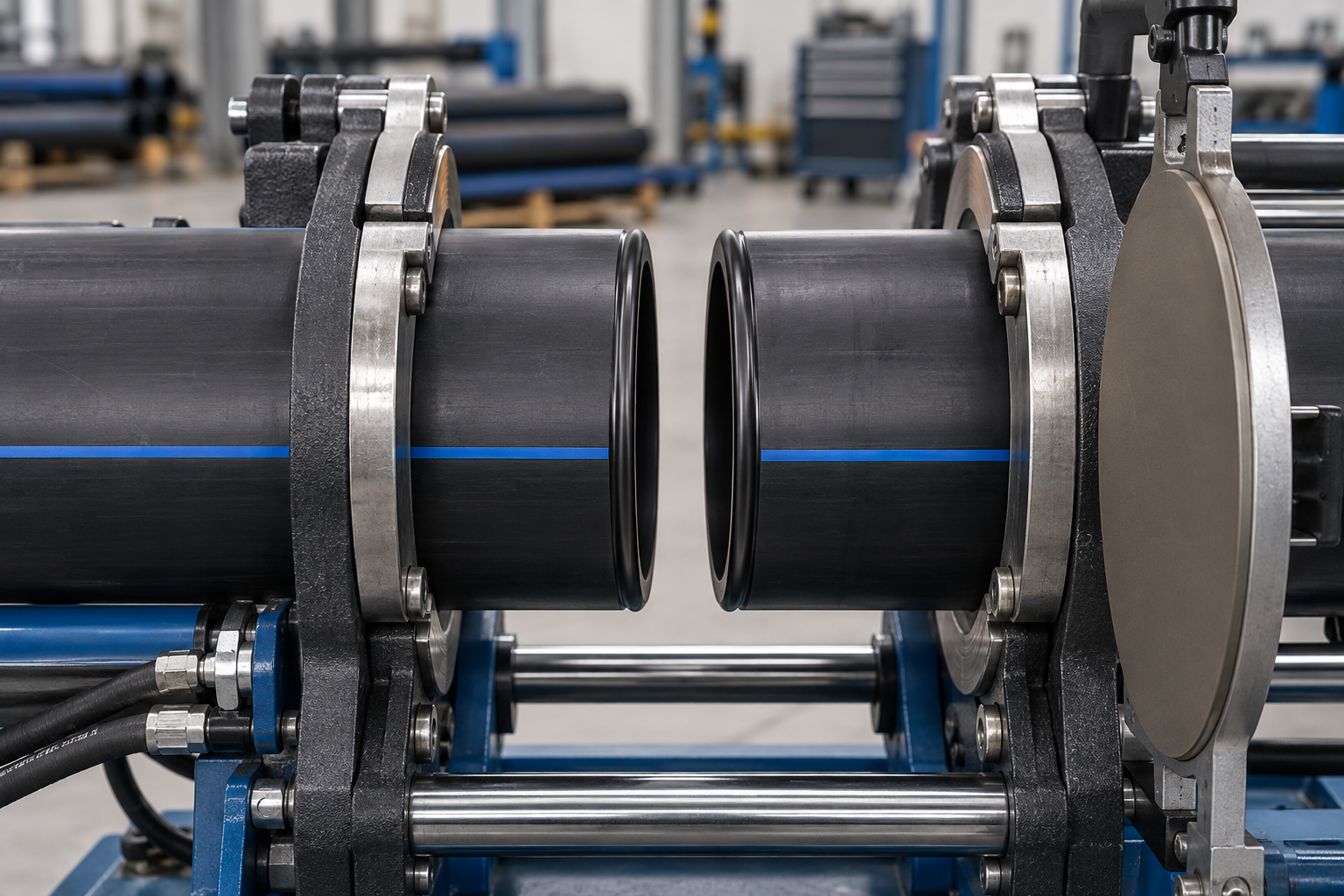
A heater temperature should never be selected from a generic internet chart without identifying the applicable fusion procedure. For example, the PPI technical explanation discusses an ASTM-based heater surface range of approximately 400–450°F (204–232°C), but other qualified procedures can use different pressure cycles and control rules. The approved standard, pipe manufacturer’s instructions, machine requirements, and project specification must govern the actual settings. See PPI TN-51-2026.
How Do Two Melted HDPE Ends Become One Joint?
The essential bonding mechanism is polymer autohesion. When two compatible molten polyethylene faces make intimate contact, molecular chains from one side begin moving into the melt layer on the other side. Chains from the opposite side do the same.
This movement is commonly described as molecular interdiffusion. The interface gradually becomes populated by polyethylene chains that cross, overlap, and entangle across what was previously the boundary between two separate components.
As heat leaves the joint, the melt returns to a semicrystalline state. The interpenetrated chains become part of the solidifying polyethylene structure, forming what PPI describes as the plane of co-crystallization. This narrow region at the center of the melt-flow zone is the functional connection between the two pipe ends.
The joint is not created because one bead grips another or because pressure mechanically locks the ends together. Its strength comes primarily from sufficient molecular contact, interdiffusion, entanglement, and controlled solidification.
When compatible materials are joined with a validated procedure, the fusion zone can develop performance comparable to the adjoining pipe. ASTM F2620 states that properly implemented procedures produce strong, pressure- and leak-tight joints, with destructive test failure occurring outside the fusion area. See ASTM F2620-24.
What Role Does Fusion Pressure Play?
Fusion pressure brings the molten faces into complete and uniform contact. It helps displace surface irregularities, establishes molecular wetting across the pipe wall, and maintains the interface while bonding and cooling progress.
Pressure does not physically push polyethylene molecules into a chemical reaction. Heat provides molecular mobility; contact time permits interdiffusion; pressure creates and maintains the intimate contact required for those mechanisms to occur.
- Insufficient interfacial pressure may leave incomplete contact, voids, or poorly consolidated areas.
- Excessive pressure may force too much hot material away from the interface and expose cooler, more viscous material before adequate interdiffusion has occurred.
- Uneven loading may produce irregular bead development and nonuniform contact around the circumference.
- Incorrect drag compensation may cause the true pressure at the pipe interface to differ from the value assumed by the operator.
Hydraulic machine pressure is not automatically the same as interfacial pressure. The required gauge setting depends on the pipe-end area, machine cylinder area, machine design, and measured drag resistance. Operators must use the calculation method specified for the selected machine and approved fusion procedure.
The Four Variables That Control HDPE Butt Fusion
The mechanism can be understood through four interdependent variables.
| Variable | What It Controls | Risk When Incorrect |
| Heater surface temperature | Thermal condition of the plate and energy transfer into the pipe end | Low temperature may produce inadequate melting; excessive temperature may degrade or overheat the surface |
| Heating and heat-soak time | Depth and uniformity of the melt-flow zone | Insufficient time can leave a shallow or cold interface; excessive exposure can create too much melt or thermal damage |
| Interfacial force or pressure | Surface contact, molecular wetting, melt displacement, and consolidation | Too little can leave incomplete contact; too much can expel the required hot material |
| Cooling time under pressure | Solidification, co-crystallization, and dimensional stability | Early release or movement can disturb a joint that has not developed sufficient strength |
These variables cannot be adjusted independently without considering pipe diameter, wall thickness, material designation, equipment, ambient conditions, and the qualified procedure.
ISO 21307 includes single low-pressure, dual low-pressure, and single high-pressure butt-fusion procedures. The existence of these different validated systems shows why a pressure value from one procedure must not be inserted into another procedure’s temperature and timing cycle. See ISO 21307:2017.
Why Does Butt Fusion Produce Inside and Outside Beads?
When the molten pipe ends are pressed together, part of the softened polyethylene flows radially away from the central interface. This displaced material forms a rollback bead on the outside diameter and another bead on the inside diameter.
The external bead is useful as a visible process indicator. Its shape, continuity, symmetry, and relationship to pipe alignment can help a trained inspector identify obvious departures from the approved procedure.
However, the bead itself is not the structural bond. PPI explains that the inner and outer beads are excess polymer from the melt-flow zone; joint strength is developed at the interdiffused region between the pipe ends. A large bead therefore does not automatically prove that a strong joint has formed.
In most pressure-pipeline applications, the internal bead remains in place. Bead removal may be specified for applications such as internal inspection, pigging, or particular process-flow requirements, but the removal tool must not cut or gouge the pipe wall.
Why Must the Joint Cool Under Pressure?
A newly joined HDPE interface remains hot, soft, and vulnerable to displacement. It does not reach its required handling strength the moment the heater plate is removed.
During cooling, molecular mobility decreases and the molten region returns to a semicrystalline solid. At the same time, crystallization and thermal contraction cause the heated material to shrink. Maintaining the prescribed fusion force allows the machine carriage to compensate for this axial shrinkage while preserving intimate contact.
If the clamps were treated as a rigid locked position without maintaining the required force response, shrinkage could place tensile stress across the still-forming interface. PPI therefore explains that hydraulic pressure is maintained during the cooling period and that the carriage moves slightly as the molten zone contracts.
The assembly should not be removed, bent, lifted by the joint, or otherwise stressed before completion of the specified cooling time. Additional cooling may also be required before rough handling or pressure testing, depending on the governing procedure and project rules.
What Can Prevent Complete Molecular Fusion?
A fusion joint may look joined externally while having inadequate molecular entanglement at part of the interface. Common causes include:
- Dirt, grease, moisture, dust, or foreign material on a prepared fusion face
- Touching or wiping a freshly faced surface with a contaminated object
- Incomplete facing that leaves weathered, damaged, or nonsquare material
- Pipe ends that are not correctly aligned
- Inadequate or uneven heater-face temperature
- Insufficient heat-soak time for the pipe size and wall thickness
- Excessive delay between heater removal and pipe-end contact
- Incorrect interfacial pressure or hydraulic-pressure calculation
- Failure to compensate for machine and pipe drag
- Movement, impact, or pressure release during cooling
- Wind, rain, low ambient temperature, or airborne contamination without adequate environmental control
- Joining materials whose polymer chemistry or dimensional characteristics are not approved as compatible
The preparation stage matters because molecular fusion can occur only where clean, compatible molten polyethylene surfaces contact each other. Facing removes unsuitable surface material while producing square and parallel pipe ends. Once faced and verified, the ends should be protected from contact and contamination.
How Is HDPE Butt Fusion Joint Quality Verified?
Reliable verification combines process control, operator competence, visual examination, traceability, and any testing required by the project.
1. Process verification
The operator should confirm that facing, alignment, heater condition, temperature, pressure, heating time, changeover time, and cooling time met the approved procedure. Automatic data-logging equipment can record heater temperature, pressures, and cycle times for comparison with specified parameters. See ASTM F3124-23a.
A data record is valuable evidence, but it does not capture every site condition. Dust, moisture, improper cleaning, wind exposure, or damage after fusion may still require separate inspection controls.
2. Visual examination
The external bead should be examined around the full circumference for continuity, symmetry, surface condition, and alignment. An unusual bead can indicate a process deviation, but an acceptable-looking bead cannot reveal every embedded discontinuity or incomplete-fusion condition.
TWI distinguishes visual examination from volumetric inspection because surface appearance alone has detection limits. Project specifications may consequently require destructive qualification tests, production cut-outs, bend or tensile testing, or approved nondestructive examination for critical installations. See TWI butt-fusion inspection guidance.
3. Operator qualification and traceability
Operator training should cover the specific machine type and fusion procedure used on the project. ASTM F3190-26 defines training, assessment, and qualification criteria for heat-fusion equipment operators working with PE and other specified thermoplastics. See ASTM F3190-26.
Joint records should identify the operator, equipment, pipe or fitting information, procedure, date, location or joint number, and recorded cycle parameters when required.
When Is Butt Fusion the Appropriate HDPE Joining Method?
Butt fusion is particularly suitable for straight PE pipe runs and compatible butt-fusion fittings when both components can be correctly clamped, faced, heated, and moved within a fusion machine.
Another joining method may be more practical when movement is restricted, the pipe cannot be positioned in a butt-fusion machine, a repair must be made in a confined space, or a transition to another material or flanged component is required.
Typical alternatives include electrofusion, socket fusion for applicable small sizes, and mechanical or flanged connections. These methods use different equipment and quality controls; they should not be treated as interchangeable versions of butt fusion.
For a dedicated selection guide, see HDPE butt fusion vs electrofusion. A wider overview is available in four common HDPE pipe joining methods.
Applicable Standards and Current Technical References
The following references were checked on September 10, 2026. A project must still determine which standard, amendment, local code, utility rule, and manufacturer procedure applies.
| Reference | Main Relevance | Status Checked |
| ASTM F2620-24 | Heat-fusion joining procedures for PE pipe and fittings | Active ASTM practice |
| ISO 21307:2017 | PE butt-fusion procedures and joint quality assessment | Confirmed current by ISO in 2023 |
| ISO 12176-1:2017 | Characteristics and performance requirements for butt-fusion equipment | Published and confirmed current |
| ASTM F3124-23a | Data recording for heat butt-fusion joint production | Active ASTM practice |
| ASTM F3190-26 | Heat-fusion equipment operator training and qualification | Active ASTM practice |
| PPI TR-33 | Validation supporting a generic PE butt-fusion procedure | PPI technical report |
| PPI TN-51-2026 | Molecular structure, melt-flow zone, beads, cooling, and terminology | Current PPI technical note |
ASTM F2620 also states that polyethylene melt characteristics and molecular-weight properties affect appropriate fusion parameters. Manufacturer instructions and procedure qualification therefore remain necessary even when a recognized standard is referenced.
What Buyers Should Confirm Before an HDPE Pipeline Project
Pipe compatibility, fusion equipment, and documentation should be planned together rather than after the pipe arrives on site.
- Pipe application: water, mining, industrial, gas, sewer, fire protection, or another service
- Outside diameter and wall dimension, including SDR, DR, or PN requirements
- Material designation and approved compatibility of pipes and fittings
- Product standard and applicable national or project code
- The qualified butt-fusion procedure to be used
- Fusion machine model, size range, condition, and calibration requirements
- Operator qualification and project-specific approval requirements
- Environmental controls for wind, rain, dust, and temperature
- Joint numbering, logging, inspection, and test requirements
- Required HDPE butt fusion fittings
- Required hydraulic butt fusion equipment
- Pipe sizes and wall dimensions using the HDPE pipe size and specification table
- Quantity, delivery destination, document package, and project schedule
RFQ note: For an accurate quotation, identify the pipe size, SDR/DR/PN, material or standard, quantity, destination country, fittings, fusion equipment, inspection documents, and expected delivery period.
Frequently Asked Questions
Does HDPE butt fusion use glue?
No. Butt fusion uses heat, intimate surface contact, molecular interdiffusion, and cooling. Adhesive is not applied between the pipe ends.
Is butt fusion a chemical weld?
The pipe does not require a separate chemical adhesive or solvent reaction. The principal mechanism is physical interdiffusion and entanglement of compatible polyethylene molecular chains across the molten interface.
Does pressure create the molecular bond?
Pressure establishes and maintains uniform contact between the molten faces. Heat and time provide the molecular mobility and interdiffusion needed to form the joint.
Why must HDPE pipe ends be faced before heating?
Facing exposes clean material and creates square, parallel surfaces. Poorly faced ends can cause gaps, misalignment, uneven heating, or contamination at the interface.
What is heat soak in HDPE butt fusion?
Heat soak is the controlled period during which heat moves from the heater into the pipe ends and establishes the required melt depth. Its duration depends on the approved procedure, pipe size, and wall thickness.
Why must heater changeover time be short?
The molten pipe faces begin losing heat immediately after leaving the heater. Excessive delay can cool the interface below the condition needed for adequate interdiffusion.
Is a larger fusion bead always better?
No. Bead size alone does not prove joint quality. Excessive force can create a large bead while displacing too much molten material from the functional joint interface.
Can two different HDPE pipe brands be butt fused?
Possibly, but compatibility cannot be assumed from the HDPE name alone. The material chemistry, dimensions, applicable standard, manufacturer approval, and qualified procedure must support the combination.
Can visual inspection prove that a fusion joint is sound?
No. Visual inspection can identify bead and alignment problems, but it cannot detect every internal or incomplete-fusion defect. Critical projects may require process records, qualification testing, destructive tests, or approved nondestructive examination.
Is ASTM F2620 the only acceptable butt-fusion procedure?
No. ASTM F2620 is a widely used validated practice, but other qualified manufacturer, company, national, or ISO procedures may be acceptable. One procedure’s temperature, pressure, and timing values should not be mixed with those of another.
Conclusion
HDPE hot plate butt fusion works because clean, compatible polyethylene surfaces are heated into a controlled molten condition, joined in intimate contact, and allowed to cool under a specified force. During this cycle, molecular chains cross the original interface, become entangled, and solidify within a shared polyethylene structure.
The heater temperature, heat-soak time, interfacial pressure, changeover time, and cooling conditions must operate as one validated system. A visually attractive bead cannot compensate for contaminated faces, insufficient heating, incorrect force, incompatible materials, or premature movement.
For project selection, the safest approach is to specify the pipe, fittings, machine, fusion procedure, operator requirements, and quality records as one coordinated package. This provides a reliable basis for producing strong, pressure-tight HDPE fusion joints in field conditions.