
14
Sep
Can HDPE Pipe Connect to PVC Fittings? How to Make the Transition
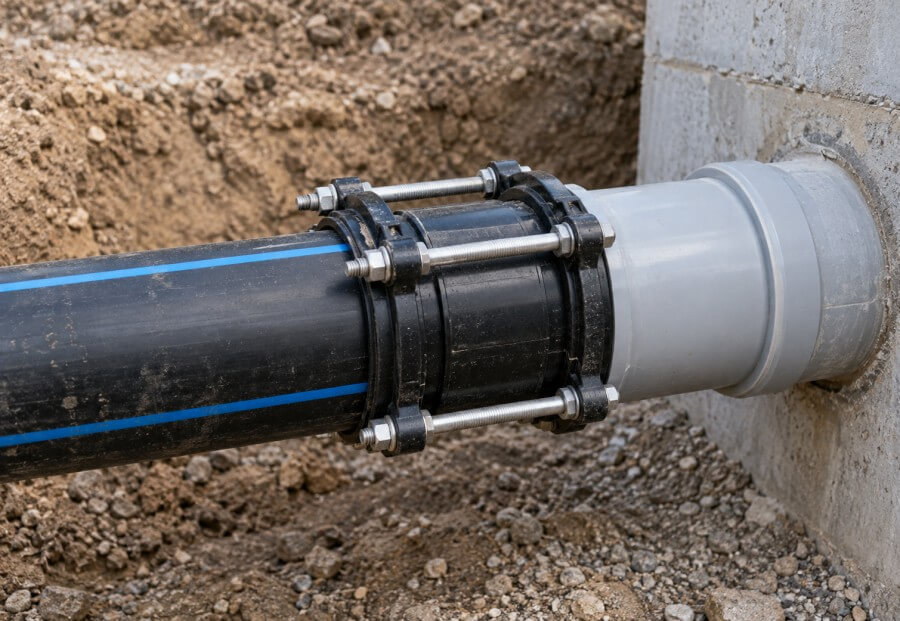
HDPE pipe can connect to PVC fittings through a dedicated transition fitting.
An HDPE pipe to PVC fitting connection should use a mechanical coupling, flanged assembly, or restrained bell adapter.
HDPE and PVC must not be directly butt-fused together.
PVC solvent cement does not create a dependable pressure joint on HDPE.
The fitting choice must match pipe dimensions, pressure, restraint needs, and the application.
For a buried or pressurized pipeline, pull-out resistance is as important as leak-tight sealing.
Contents
- Can HDPE Pipe Connect to PVC Fittings?
- Why Direct Fusion or PVC Glue Does Not Work
- Three Reliable HDPE-to-PVC Connection Methods
- How to Select the Correct Transition Fitting
- Installation Checks
- Buyer RFQ Checklist
- FAQ
Can HDPE Pipe Connect to PVC Fittings?
Yes. HDPE and PVC can be integrated into one pipeline when the connection is designed as a transition between two different materials.
The key point is that the fitting must work with the actual outside diameter and wall behavior of both pipes. A nominal “110 mm” or “4 inch” label does not prove compatibility, because HDPE and PVC may follow different dimensional series.
For pressurized water systems, the transition should provide three functions:
- A seal around each pipe material.
- Resistance to axial pull-out.
- A pressure rating equal to or above the project requirement.
Before selecting a coupling, buyers should compare the HDPE pipe’s OD, SDR or DR, and pressure class with the PVC pipe or fitting dimensions. See the HDPE pipe specification and size table for a starting point.
Why Direct Fusion or PVC Glue Does Not Work
HDPE butt fusion is a polyethylene-to-polyethylene joining process. The heated pipe ends form one continuous PE joint only when the materials are compatible.
PVC has different thermal behavior from HDPE. Heating HDPE and PVC together does not produce a qualified fusion joint and may damage the pipe ends.
PVC solvent cement is also unsuitable for HDPE. Solvent cement works by softening PVC surfaces before they bond together. HDPE has a highly chemical-resistant surface that does not form the same solvent-welded bond.
Electrofusion does not solve this material mismatch. It can join an electrofusion fitting to an HDPE pipe, but the PVC side still needs a mechanical, flanged, or purpose-built transition interface.
Three Reliable HDPE-to-PVC Connection Methods
1. Restrained mechanical transition coupling
A restrained mechanical coupling is usually the most direct solution for joining plain-end HDPE pipe to plain-end PVC pipe.
The coupling uses elastomeric gaskets to seal around each pipe end. Its restraint system—such as grip rings, teeth, or locking elements—helps prevent the HDPE pipe from moving out of the fitting under pressure.
This option is commonly used for:
- Repairing an existing pipeline
- Extending a PVC line with HDPE pipe
- Connecting two different materials in a buried water system
- Field work where the PVC side cannot be fused
The coupling must be specifically listed by its manufacturer for both HDPE and PVC. A flexible sleeve intended only for drainage should not be assumed suitable for a pressure pipeline.
2. Flanged transition assembly
A flanged transition is a strong choice at valves, pumps, flow meters, treatment equipment, and chambers where the connection may need to be removed later.
A typical arrangement includes:
- HDPE stub end butt-fused to the HDPE pipe
- HDPE backing ring
- Gasket
- Compatible PVC flange adapter or flanged fitting
- Correct bolts, washers, and tightening sequence
This arrangement separates the permanent HDPE fusion joint from the removable flange connection. It is especially practical when an HDPE main connects to a PVC valve manifold.
For the HDPE-side joining process, link to common HDPE pipe joining methods.
3. PVC bell transition with PE restraint
A PVC bell connection needs more attention than a standard PVC push-on joint when the inserted pipe is HDPE.
HDPE is more flexible than PVC. If an HDPE pipe end is inserted into a PVC bell without the correct transition design, gasket loading and movement may not be controlled correctly.
A proper PE-to-PVC bell transition may include:
- An HDPE internal stiffener
- A compatible gasket interface
- A restraint harness or locking system
- Defined insertion depth
- Thrust or pull-out control
The internal stiffener supports the HDPE pipe wall so the seal and restraint system can perform as designed.
How to Select the Correct Transition Fitting
| Selection Item | What to Confirm |
|---|---|
| Application | Potable water, industrial water, drainage, irrigation, temporary bypass, or another service |
| HDPE pipe data | Outside diameter, SDR/DR, material grade, wall thickness, and end condition |
| PVC-side data | Pipe or fitting type, actual OD, plain end, flange, or bell configuration |
| Pressure | Operating pressure, surge condition, and hydrostatic test pressure |
| Restraint | Pull-out resistance, thrust blocks, restrained joints, or harness requirements |
| Temperature | Maximum operating temperature and expansion conditions |
| Installation | Buried, above ground, valve chamber, equipment room, or repair location |
| Documentation | Manufacturer compatibility statement, torque instructions, and project standards |
A transition fitting should be selected as part of the full pipeline design. It is not simply a connector between two nominal pipe sizes.
Installation Checks
Start by cutting both pipe ends square. Remove damaged, deeply scratched, oval, or deformed sections before installation.
Measure the actual outside diameter where the connection will be made. Do not rely only on markings printed on the pipe.
If the fitting manufacturer requires an HDPE stiffener, install the specified model and insertion depth. Do not replace it with a generic metal sleeve or an unapproved insert.
For mechanical couplings, tighten bolts evenly in the prescribed sequence. Uneven tightening can create poor gasket compression or overstress one side of the fitting.
For flanged assemblies, use a cross-pattern tightening sequence. PVC flange components can crack if bolts are over-tightened.
Support heavy valves, pumps, and equipment independently. Their weight should not be transferred through an HDPE-to-PVC transition joint.
Finally, pressure-test the completed system under the approved project procedure. A joint that passes a static pressure test may still require additional restraint if it is located near bends, tees, closed valves, or other thrust points.
Common Mistakes to Avoid
- Trying to butt-fuse HDPE directly to PVC
- Using PVC solvent cement on HDPE
- Selecting a coupling only by nominal size
- Ignoring different OD systems
- Using an unrestrained flexible sleeve on a pressure main
- Omitting an HDPE stiffener where required
- Over-tightening bolts on PVC flanges
- Allowing valve or pump weight to load the transition fitting
- Assuming leak-tightness alone proves the connection is restrained
FAQ
Can HDPE be glued to PVC?
No. PVC solvent cement does not create a reliable structural or pressure bond on HDPE. Use a specified mechanical transition or flange connection.
Can HDPE and PVC be butt-fused together?
No. Butt fusion is intended for compatible polyethylene materials. HDPE and PVC require a transition fitting.
Can a rubber coupling connect HDPE and PVC?
It can only be used when the exact coupling is approved for both materials, the measured pipe OD range, and the intended pressure or drainage duty.
When is an HDPE internal stiffener required?
It is often required when an HDPE pipe enters a mechanical coupling or PVC bell fitting that applies gasket and restraint loads to the pipe wall. Confirm the requirement with the fitting manufacturer.
Is a flange connection better than a mechanical coupling?
Neither method is always better. A mechanical coupling is often practical for field repairs and plain-end transitions. A flanged assembly is normally preferred at removable equipment interfaces such as valves, pumps, and meters.
Conclusion
HDPE pipe can connect safely to PVC fittings, but the connection must be engineered for two different materials. Use a restrained mechanical transition coupling for plain-end field connections, a flanged assembly for equipment interfaces, or a restrained PVC-bell adapter where a bell-and-spigot transition is required.
The final choice should be based on actual pipe dimensions, pressure, restraint requirements, and the fitting manufacturer’s confirmed application range.