16
Sep
Why Can an Electrofusion Joint in an HDPE Gas Pipe Fail After Passing a Pressure Test?
An HDPE gas pipe electrofusion joint failure can occur after a passed pressure test because the test and the fusion interface answer different questions. The test confirms that the pipeline segment showed no detectable leak under the specified test conditions. It cannot, by itself, confirm complete bonding across the entire electrofusion interface or predict how a locally weak joint will respond to later service loads. Incomplete scraping, contamination, poor fit, incorrect fusion input, or movement during cooling can leave a joint temporarily leak-tight; pressure cycling, temperature change, ground movement, bending, shear, or environmental aging can then turn that latent weakness into a leak or fracture.
What Does a Passed Pressure Test Actually Prove?
A field pressure test evaluates the assembled pipeline segment under a defined combination of pressure, temperature, test medium, and duration. Its immediate result is simple: did the segment reveal a leak during that test?
In the United States, 49 CFR §192.513 requires a plastic pipeline test procedure capable of finding potentially hazardous leaks in the tested segment. The regulation addresses leak discovery at pipeline level. Separate rules govern how a plastic joining procedure is qualified and how a person is qualified to make production joints.
That separation matters. Under §192.281, electrofusion must use the fitting manufacturer’s prescribed equipment and techniques, or an equivalent method proven by testing. §192.283 addresses written procedure qualification with specimen joints, while §192.285 covers the qualification of people who make the joints.
The evidence therefore has three distinct layers:
- The pipeline test shows whether the tested segment leaked under the specified conditions.
- Procedure qualification shows that the joining method can produce acceptable joints within its qualified scope.
- Person and process records show whether the field joint was made by a qualified operator using the required preparation, equipment, parameters, restraint, and cooling time.
A pipeline can pass the first layer even when one joint contains a local interface weakness that has not yet formed a through-leak path.
How Can a Weak Electrofusion Joint Still Pass?
An electrofusion joint may contain both soundly bonded material and a local region with poor bonding. If the bonded region still forms a continuous seal and carries the short-term test load, the joint may show no leakage. Its effective bonded area, resistance to crack growth, or tolerance of bending and shear can nevertheless be lower than intended.
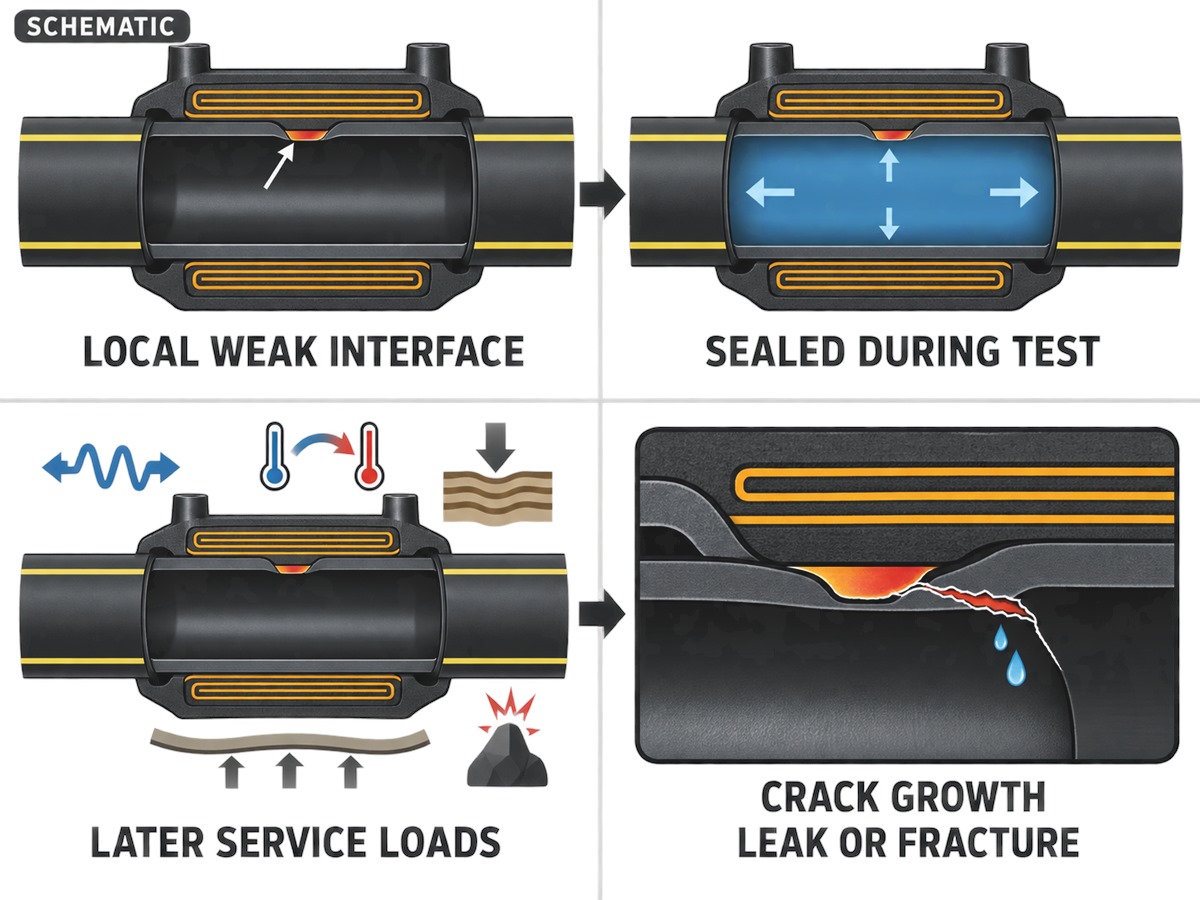
This distinction appears in research on electrofusion joints for polyethylene natural-gas networks. Tutunchi and co-authors found that improper scraping created substantial brittle-fracture areas, and even a small unscraped region reduced joint strength. Lipid-contaminated specimens satisfied the acceptance criteria used in the study while their fracture surfaces still showed considerable brittle behavior. The study’s tests were performed on joint specimens rather than an installed pipeline segment, but the result explains the key mechanism: a short-term acceptance result and a latent interface weakness can coexist. Read the study.
The remaining bonded zone can therefore keep gas or test medium inside the pipe during commissioning. The weak region becomes critical when later loading concentrates stress at the edge of incomplete fusion or a contaminated interface.
For a basic explanation of the heating-coil process, see how HDPE electrofusion fittings work.
Which Installation Defects Leave a Latent Weak Interface?
The PPI TR-49 electrofusion guide for PE gas piping identifies pipe preparation as a critical field control and describes improper preparation as the leading cause of unsuccessful electrofusion attempts. Contamination is the next major cause identified in the guide. PHMSA’s guidance for small LP gas systems also emphasizes scraping, cleaning, insertion marking, alignment, clamping, adequate power, and full cooling.
| Latent condition | Effect at the fusion interface | Why the pressure test may not reveal it immediately | Evidence to review |
|---|---|---|---|
| Incomplete or uneven scraping | Oxidized or contaminated surface remains in part of the fusion zone, reducing molecular bonding and effective bonded area | Other parts of the interface may still form a continuous short-term seal | Scraped-area witness marks, scraper condition, preparation method, and any recorded interruption before assembly |
| Oil, dirt, dust, or moisture contamination | A local weak or brittle region forms where clean molten PE surfaces should join | The contaminated area may not yet connect the pipe bore to the outside surface | Cleaning material, handling sequence, protected storage, weather exposure, and contact with hands, tools, or soil |
| Misalignment, ovality, or incomplete insertion | Fusion-zone clearance, melt pressure, and load distribution become uneven | Initial sealing can occur while residual stress or a reduced fusion zone remains | Insertion-depth marks, pipe-end condition, re-rounding method, clamps, and alignment records |
| Incorrect energy input or power delivery | The fitting receives too little, too much, or uneven heat for the intended cycle | A completed controller cycle cannot verify surface preparation, fit, or uniform heat transfer | Fitting barcode or entered parameters, control-unit record, voltage supply, leads, extension cable, and error messages |
| Movement before full cooling | The still-soft fusion zone is displaced or loaded, introducing damage or residual stress | The damaged region may remain closed until later bending, shear, or pressure loads act on it | Manufacturer cooling time, clamp-removal time, movement, tapping, testing, and handling sequence |
These conditions are process-specific. The control unit delivers the programmed electrical cycle, but it cannot see whether the pipe was scraped completely, touched after cleaning, inserted to the correct depth, or held without movement through the required cooling period.
Broader trenching, alignment, backfill, and installation issues are covered in common HDPE gas pipe installation mistakes.
What Causes the Joint to Fail Later?
A latent interface defect changes where stress is carried. Instead of being distributed through the intended fusion zone, stress becomes concentrated around the edge of an unscraped, contaminated, poorly fitted, or disturbed region. Later service conditions can then extend that weak region.
- Pressure loading: start-stop changes cycle the load, while sustained internal pressure continues to load the remaining bonded area.
- Temperature change: pipe contraction, expansion, and bending can transfer axial or angular load into the fitting.
- Ground and installation movement: settlement, loss of support, rough backfill, pipe displacement, or an unsupported transition can introduce bending and shear.
- Environmental aging: chemicals present in the surrounding soil can accelerate deterioration at an existing welding defect.
A 2024 field study examined leakage at an electrofusion joint in an in-service PE gas pipeline in Guocun, Beijing. The researchers reported that organic surfactants in the soil accelerated aging, particularly around a welding defect, and reduced the joint’s resistance to external force. This is a direct example of an existing weld weakness interacting with the service environment. View the paper record.
The East Harlem gas accident provides a related load-path example involving a saddle heat-fusion service tee, not an electrofusion joint. The NTSB safety alert states that incomplete fusion can be strong enough to pass initial pressure testing and fail later. In the accident investigation, loss of soil support allowed the gas main to sag and overstress the weak service-tee joint. The documented sequence—weak fusion followed by concentrated external load—shows why the loading history after commissioning belongs in a joint-failure investigation.
What Evidence Should Be Reviewed After a Post-Test Failure?
An investigation should connect the observed failure to the records that describe how the joint was designed, made, tested, and loaded. Five evidence layers provide that connection.
- Procedure and compatibility
Confirm the fitting manufacturer’s joining instructions, the pipe and fitting compatibility, and the qualified procedure that covered the product and size. A generic electrofusion procedure is not a substitute for the fitting-specific parameters and preparation method.
- Person qualification
Verify that the operator’s qualification was current and relevant to the procedure used. Where required, review specimen-joint, cut-strap, physical, or ultrasonic qualification records.
- Process record
Review scraping coverage, cleaning and handling, insertion depth, alignment, clamping, power supply, control-unit inputs and errors, fusion time, and full cooling time. A cycle-complete record confirms the electrical sequence recorded by the unit; the preparation and mechanical controls require their own evidence.
- Test and inspection record
Check the pressure-test medium, pressure, temperature, duration, stabilization method, and observed result against the applicable project and regulatory procedure. Review visual observations and any project-specified destructive sample or nondestructive examination together with that test record.
- Post-test loading
Examine pipe support, backfill, settlement, thermal movement, handling, tapping, nearby construction, and any abnormal event between testing and failure. This step determines whether later bending, shear, displacement, or environmental exposure acted at the weak interface.
No single record covers all five layers. A normal external appearance cannot reveal every internal interface condition, and a control unit cannot verify preparation or restraint. Nondestructive examination also has method-specific limits. In PHMSA R&D Project 187, phased-array ultrasonic testing detected small planar flaws in project specimens, but fitting geometry blocked part of the fusion zone and several contamination, misalignment, and lack-of-fusion conditions were not detected reliably in the limited sample set.
Reliable joint acceptance therefore combines a qualified product and joining procedure, qualified personnel, documented preparation and fusion, full cooling, inspection, and the required pipeline pressure test. For system-specific product information, see Puhui’s HDPE gas pipe and HDPE electrofusion fittings.