16
Sep
What Projects Commonly Use 315 mm HDPE Pipe?
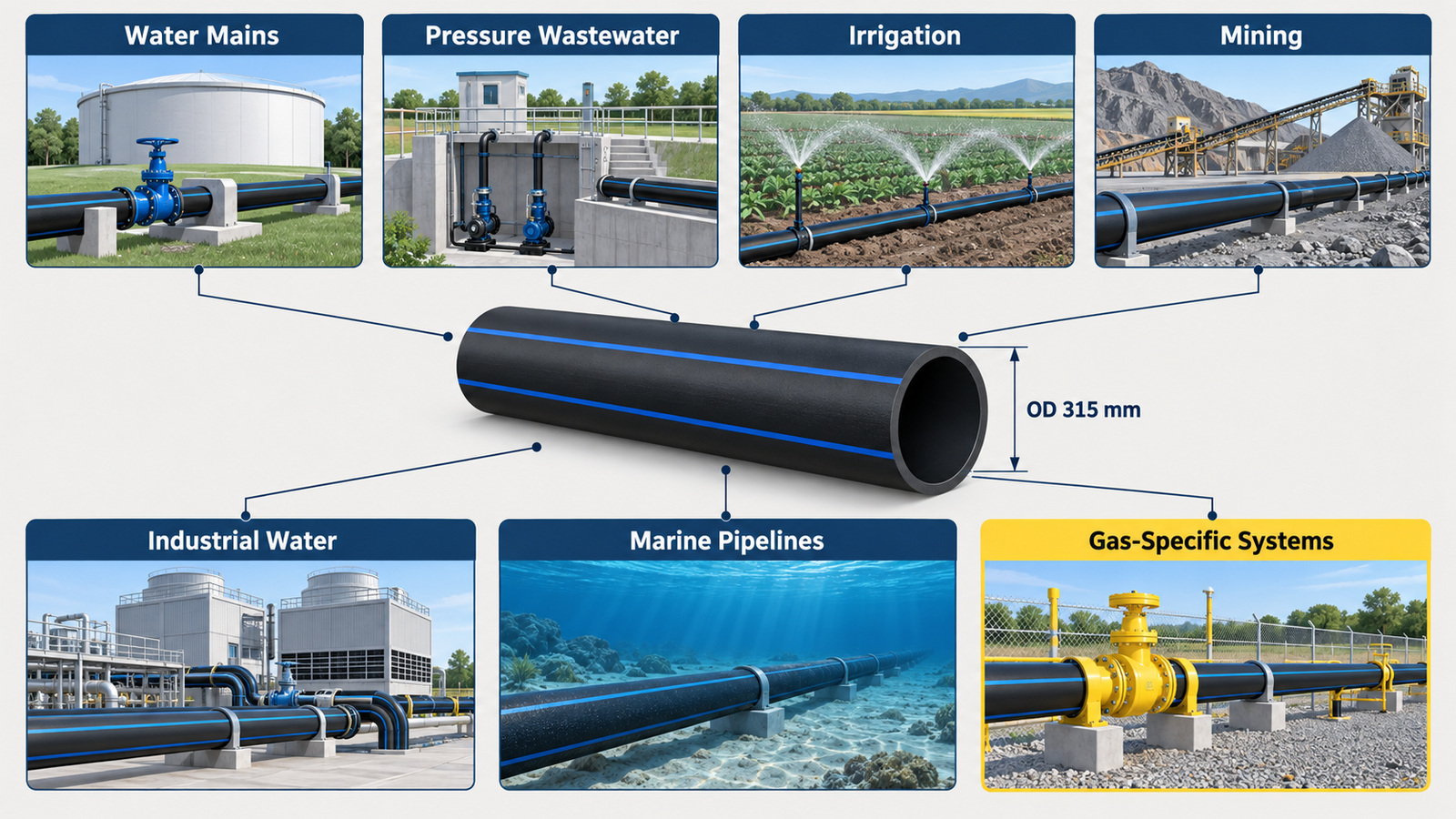
Common 315mm HDPE pipe applications include municipal and raw-water mains, pressure wastewater lines, irrigation mains, and selected mining or industrial systems.
The same diameter also appears in marine intake, outfall, and submerged-crossing projects, as well as in gas-specific PE systems.
In these projects, 315 mm pipe usually serves as a main, trunk, or process line rather than a small service connection.
The 315 mm value normally describes the nominal outside diameter.
Pipes with the same outside diameter can have different wall thicknesses, inside diameters, materials, pressure capabilities, and governing standards.
The application therefore selects the pipe system; the diameter does not select the application.
Which Projects Use 315 mm HDPE Pipe?
Municipal Potable-Water and Raw-Water Mains
A 315 mm PE line is commonly considered for distribution mains, raw-water transfer lines, and transmission sections. It is much larger than a typical property service, so its role is usually to move water between treatment, storage, pumping, and distribution assets.
ISO 4427-2 covers PE pipes for drinking water, raw water before treatment, and water drainage or sewerage under pressure. That scope confirms the application family, not the suitability of one pipe for every water project. Surge pressure, route length, elevation, and the required drinking-water approval still belong to the project design.
For available dimensions and wall configurations, use the HDPE pipe size and SDR reference. Do not treat the outside diameter as a flow or pressure rating.
Pressure Wastewater and Leachate Lines
315 mm solid-wall pressure pipe can be used for pumped sewer mains, pressure drainage, and defined industrial leachate duties. These lines face pump starts and stops, pressure transients, suspended solids, and a medium that may be more aggressive than clean water.
Pressure pipe and gravity drainage pipe are not the same product. A structured-wall gravity pipe may also carry a 315 mm size label, but its construction and design basis differ from a solid-wall force main. The duty must be identified before the product family is selected.
Large Irrigation Mains
In a large irrigation network, 315 mm pipe may form the backbone between a pump station and field zones. It becomes relevant when several zones operate together or when water must travel a long distance with enough pressure remaining at the far end.
The critical issues are peak simultaneous demand, elevation change, friction loss, and pressure changes caused by pumps and valves. A small farm may not need this diameter; a long or high-flow scheme may. The hydraulic result, not the crop type, decides.
Mining Process Water, Dewatering, Slurry, and Tailings
Mining systems use PE pipe for process water, pit dewatering, dust suppression, and some slurry or tailings services. The Plastics Pipe Institute’s mining guidance identifies these as established PE application groups.
Slurry duty is not ordinary water duty. Particle size, solids concentration, velocity, abrasion, changing operating conditions, and the chemical makeup of the liquid can control the design. A 315 mm water pipe should never be assumed suitable for slurry only because its diameter matches the line plan.
Industrial Process-Water and Cooling-Water Lines
Industrial plants may use 315 mm PE for process-water headers, cooling-water circuits, or other compatible fluid services. The diameter suits a main-line role where a plant must distribute or return a substantial flow.
The medium and temperature matter as much as the pressure. Chemical compatibility, operating cycles, external loads, and support spacing must be checked for the specific service. “Chemical resistant” is not a valid blanket approval for every industrial fluid.
Marine Intakes, Outfalls, and Submerged Crossings
PE pipe can be assembled on shore, floated into position, and submerged for an intake, outfall, lake crossing, or coastal crossing. The flexibility and fused joints are useful, but the installation is a marine engineering operation rather than a routine buried main.
The design must control buoyancy, concrete or other weights, currents, waves, seabed conditions, towing, sinking, and the final alignment. ISO 4427 includes pipes laid in water within its water-system scope, while the detailed installation remains project-specific.
Gas-Specific Distribution Mains
A 315 mm PE main can distribute gaseous fuel only when it is part of a gas-specific piping system. A water pipe with the same outside diameter is not an acceptable substitute.
ISO 4437-2 defines characteristics for PE pipes used to supply gaseous fuels. The selected pipe must meet the applicable gas standard, compound, identification, jointing controls, traceability, and local regulatory approval. Puhui’s HDPE gas pipe page describes this as a separate product system.
The same 315 mm diameter can therefore require a completely different pipe system when the conveyed medium or project environment changes.
What Do Real 315 mm HDPE Pipe Projects Show?
An 8.6 km Submerged Potable-Water Pipeline
At Lake Traunsee in Austria, an 8.6 km underwater potable-water pipeline used OD 315 mm PE100 pipe. The published project record identifies both SDR 9 and SDR 11 sections.
This is strong evidence that 315 mm PE can serve a long submerged drinking-water route. It also proves a more important point: one project can use the same outside diameter with different wall configurations. The project’s SDR choices are not recommendations for another route with different depth, pressure, temperature, or installation loads.
A 700 m Industrial Leachate-Drainage Line
At an industrial slag-storage site in Austria, about 700 m of DN/OD 315 mm PE100 and PE100-RC pipe was installed for leachate drainage. The project description records 315 × 28.6 mm SDR 11 pipe.
This case supports a specific industrial drainage and leachate application. It does not prove that the same pipe is suitable for every wastewater composition, chemical medium, or gravity-drainage system.
Together, the two projects show why “315 mm” is not a complete specification. The same outside diameter served different media, routes, environments, and system requirements.
Why Can Two 315 mm HDPE Pipes Be Different?
315 mm Is Outside Diameter, Not Inside Diameter
In the metric solid-wall PE system, 315 mm normally refers to nominal outside diameter. The bore is smaller and changes with wall thickness.
That difference affects hydraulic area, flow velocity, and head loss. A calculation based on a 315 mm inside diameter will overstate the available waterway and can produce the wrong pump or pipe selection.
Different SDR Values Mean Different Wall Configurations
SDR is the ratio between nominal outside diameter and nominal wall thickness. At the same 315 mm OD, a lower SDR has a thicker wall and a smaller bore than a higher SDR.
Commercial listings demonstrate that 315 mm PE100 water pipe exists in more than one configuration, including SDR 11, SDR 17, and SDR 21. These are manufacturer catalog examples, not a universal pressure table. The governing standard, material designation, temperature, design factor, and operating conditions determine the permitted rating.
315 mm Is Not Necessarily 12-Inch IPS
315 mm belongs to a metric outside-diameter series. “12-inch IPS” belongs to a different nominal dimensional series, so the labels must not be treated as identical.
The practical risk appears at connections. If the pipe, fitting, flange adapter, or valve is ordered from the wrong series, their mating dimensions may not match. Confirm the actual OD and dimensional standard instead of converting the name approximately.
The Same OD Does Not Mean the Same Pipe System
Water pressure pipe, gas pipe, gravity drainage pipe, and conduit can all be sold with a 315 mm size description. They may differ in compound, wall construction, color or marking, allowable service, fittings, testing, and governing standard.
This is why a general PE100 or PE4710 pressure-pipe system and a gas-specific system must be evaluated separately. A matching diameter makes connection possible only when the dimensional series and components also match; it does not make the products interchangeable.
315 mm HDPE pipe is most often considered for water, pressure wastewater, irrigation, mining, industrial, marine, and gas-main projects where a trunk or process line of this scale is justified.
Application selects the correct pipe system, not diameter. When requesting a 315 mm HDPE pipe, identify the application and dimensional standard first so the quoted pipe belongs to the correct system.