
14
Oct
What HDPE Pressure Pipe Should You Choose for High-Head Mine Dewatering?
Choose a PE100 or PE100-RC pressure pipe whose temperature-adjusted capacity meets the calculated pressure conditions along the entire mine dewatering line. Compare normal operation, pump shut-off and transient events, then select the SDR and actual bore together. SDR9/PN20 and SDR7.4/PN25 are useful options to assess for higher-pressure duties; the final choice follows the hydraulic profile rather than lift height alone.
Core Requirements for High-Head Dewatering
High-head dewatering combines a substantial elevation change with pump operation, mine-water chemistry and demanding pipe support conditions. The pipe system needs:
- Pressure capacity for the operating conditions and the applicable surge assessment.
- Material compatibility with the actual mine-water composition, concentration and temperature.
- Supports and restraint for pipe weight, thermal movement and loads along steep routes.
- Enough internal bore to deliver the required flow without excessive friction loss.
- Joints, fittings and valves rated for their local pressure and operating conditions.
Puhui’s HDPE mining pipe applications include mine and pit dewatering. For a high-head discharge main, the key selection task is matching the complete pipe system to the calculated pressure profile.
Key Selection Parameters
PE100-RC provides increased resistance to slow crack growth while retaining the same minimum required strength classification as PE100. It is useful where installation creates greater scratch or point-load exposure, including suitable trenchless routes. Its pressure class still comes from the material strength basis, SDR and design coefficient. The PE100+ material guide explains this distinction.
For the PE100 water-pipe rating basis at 20°C with a design coefficient of 1.25, common SDR/PN pairings are:
| SDR | Nominal pressure class | Selection implication |
|---|---|---|
| 11 | PN16 | Assess where the calculated duty fits the adjusted capacity. |
| 9 | PN20 | A thicker-wall option for higher pressure. |
| 7.4 | PN25 | Further pressure capacity with a smaller bore at the same outside diameter. |
| 6 | PN32 | A high-pressure option requiring suitable product and component availability. |
Check the specified product standard and material designation when reading the rating. ASTM PE4710 pressure ratings use their own design basis; they should be evaluated from the selected product’s rating rather than transferred from this PE100 table.
Lower SDR means a thicker wall. At a fixed outside diameter, that reduces the bore and raises velocity at the same flow rate. The HDPE specification and size table helps connect outside diameter, wall thickness and pressure class.
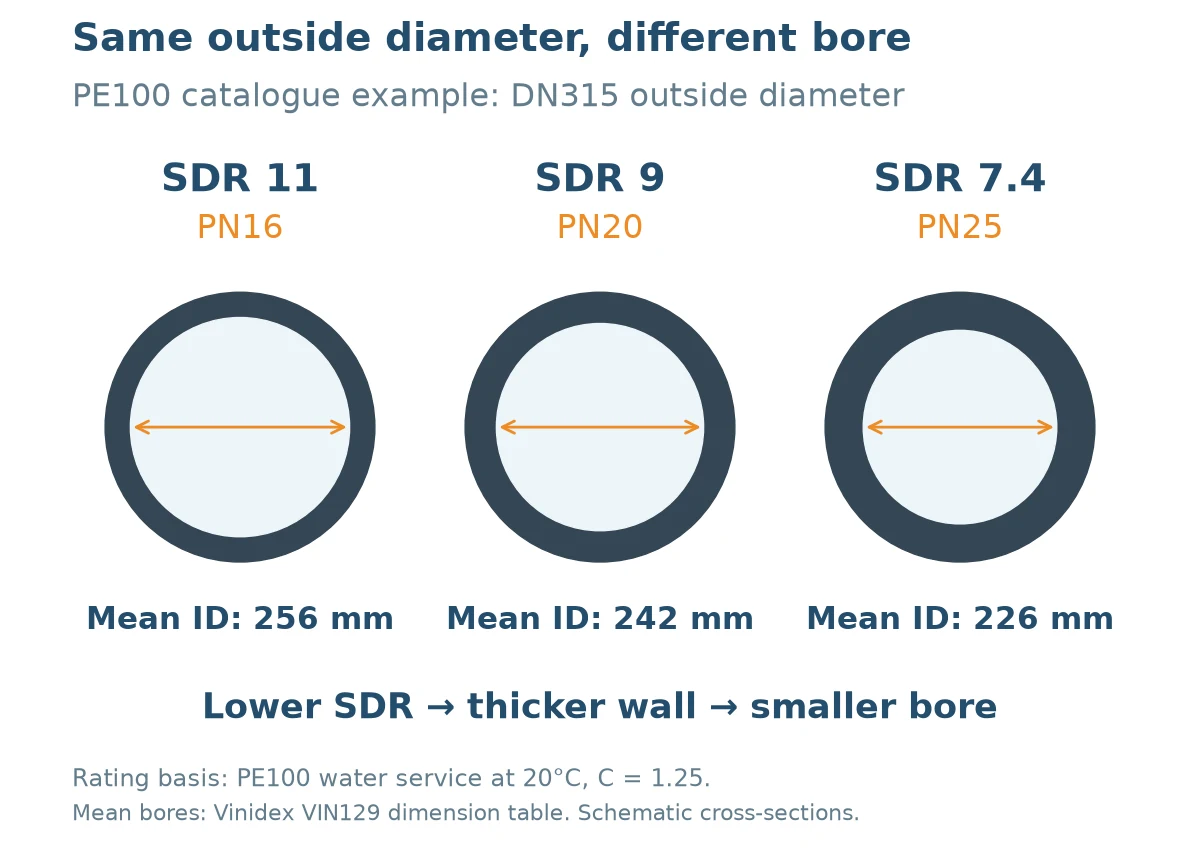
Use the actual internal diameter in the hydraulic model. Where dewatering water carries appreciable settling solids, review the diameter and conveying-velocity calculation alongside the pressure calculation.
Match Pressure Class to the Full Pressure Envelope
Static water head gives an initial pressure check:
p_static = ρgH / 100,000, with pressure in bar.
For water at a density of 1,000 kg/m³ and g = 9.81 m/s², p_static ≈ 0.0981 × H, where H is the vertical water-column height in metres. A 150 m column produces about 14.72 bar; a 250 m column produces about 24.53 bar.
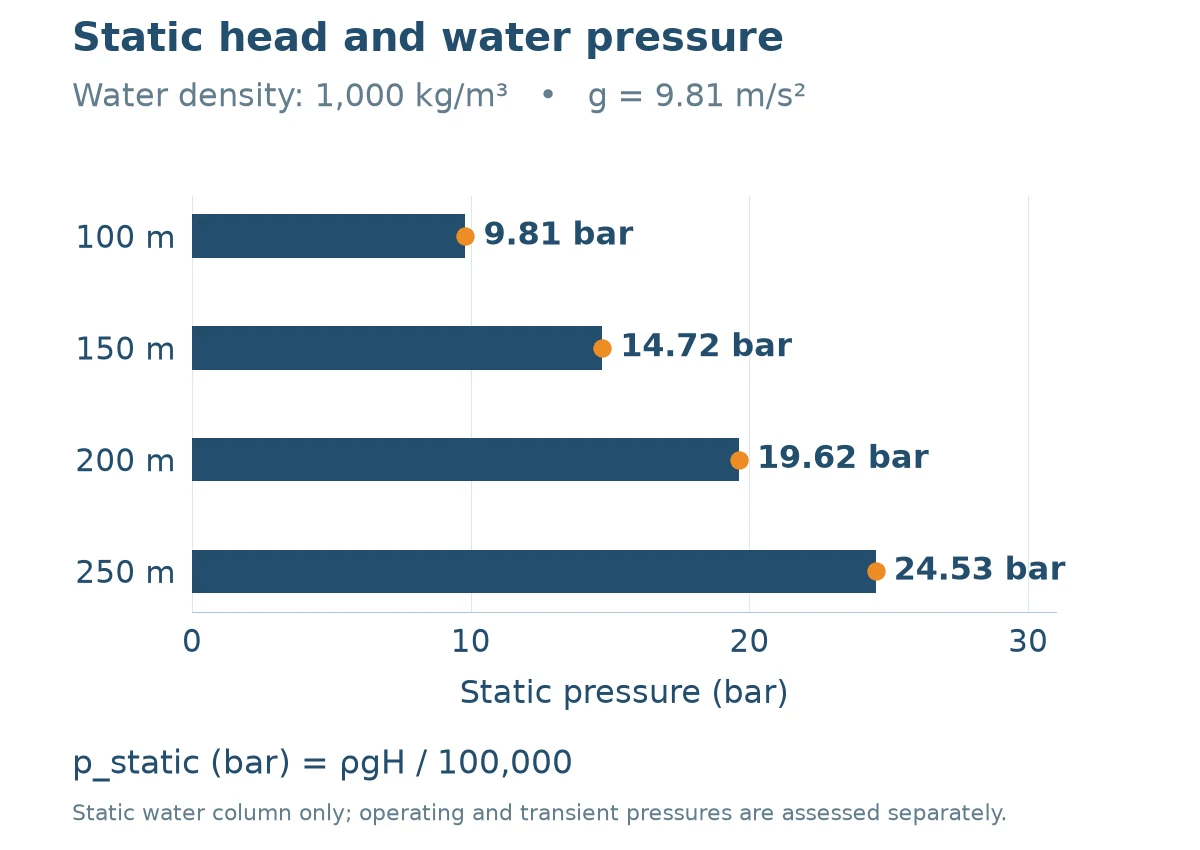
These values explain why matching a 250 m lift directly to PN25 leaves very little capacity for other effects. Determine local pressure along the route from elevation, flow losses, boundary conditions and the pump curve. At shut-off, use the pump’s differential shut-off head with the suction-side pressure to determine discharge pressure; do not add the same static lift again.
Analyse startup, pump trips and valve movements to establish maximum and minimum transient pressures. Check recurring and occasional surge against the applicable pipe-system limits, and assess low-pressure or vacuum conditions separately. KSB’s surge-pressure guide shows why this pressure envelope changes along a pipeline.
Apply the selected material’s temperature factors to the sustained-pressure rating. For an exposed route, assess pipe-wall service temperature as well as water temperature. The temperature correction can change which PN class satisfies the duty.
Simple Selection Steps
- Establish the route elevations, water levels and required flow range.
- Calculate operating pressures and friction losses, then assess pump shut-off and transient conditions without double-counting head.
- Apply the selected material’s temperature and design factors; compare each candidate with the applicable sustained and surge limits.
- Select candidate SDRs and confirm their actual bores, velocity, friction losses and pump duty.
- Check supports, slope restraint, external loads, water chemistry and any abrasion allowance.
- Specify compatible pipe, fittings, valves and joining procedures, then verify the assembled system to the project test requirements.
For permanent runs, properly executed butt fusion creates a continuous joined HDPE line. Pump and valve interfaces commonly need removable transitions. The HDPE pipe joining-method guide explains where fusion and flange connections fit the system.
Common Mistakes to Avoid
- Selecting PN from vertical lift alone and overlooking friction, shut-off or surge.
- Adding static lift to pump differential head when the same lift is already included in the hydraulic assessment.
- Using a 20°C pressure class without checking service temperature.
- Choosing the thickest wall without recalculating bore and pump power.
- Treating PE100-RC as a higher pressure class solely because of its crack resistance.
- Rating the pipe correctly while overlooking a lower-rated fitting, valve or transition.
Practical Performance
HDPE’s resistance to electrochemical corrosion can be valuable in mine-water service. Match chemical compatibility to the water analysis, and account for abrasive solids where they are present. Along exposed or steep routes, support spacing, restraint and thermal movement affect service performance as well as pressure rating.
For exposed mining lines, evaluate UV-stabilised material and solar heating. A white co-extruded HDPE pipe is one configuration to assess when surface heating is relevant; specify its pressure-rated construction and use the resulting service temperature in the design.
Conclusion
Select the PE100 or PE100-RC pipe, SDR and bore as one hydraulic and structural decision. The suitable high-head dewatering pipe meets the local sustained-pressure and surge requirements after temperature adjustment, while delivering the required flow through a fully rated system.
Visit our hdpe pipe and fittings or speak with our engineering team for technical support and project references.