
29
Oct
HDPE or PVC Pipe for Farm Irrigation Main Pipes?
Conclusion first:
For most farmland irrigation main pipes (the primary trunk lines that carry water under pressure over longer distances), HDPE is the better choice. It delivers superior leak resistance, longer service life, better flexibility in challenging soils and terrain, and lower total cost of ownership over 20–50 years. PVC remains a workable option for short, low-pressure, flat-terrain systems with tight initial budgets—but for reliable, long-term mainline performance, HDPE is the preferred material in modern irrigation design.
This guide compares the two materials on the factors that matter most to farm owners, project engineers, and irrigation contractors: leakage risk, lifespan, terrain adaptability, chemical and weather resistance, installation, and real-world cost. It ends with a simple decision framework so you can choose correctly for your project.
Why Main Pipes Are Different from Lateral or Drip Lines
Irrigation main pipes operate under continuous or cyclic pressure, often buried, and must deliver water reliably across hundreds or thousands of meters. A single leak or failure on the mainline wastes significant water, energy, and fertilizer (especially in fertigation systems) and can interrupt irrigation for an entire zone. Branch lines and laterals have different priorities (lower pressure, easier replacement, lower unit cost). The comparison below focuses only on mainline requirements.
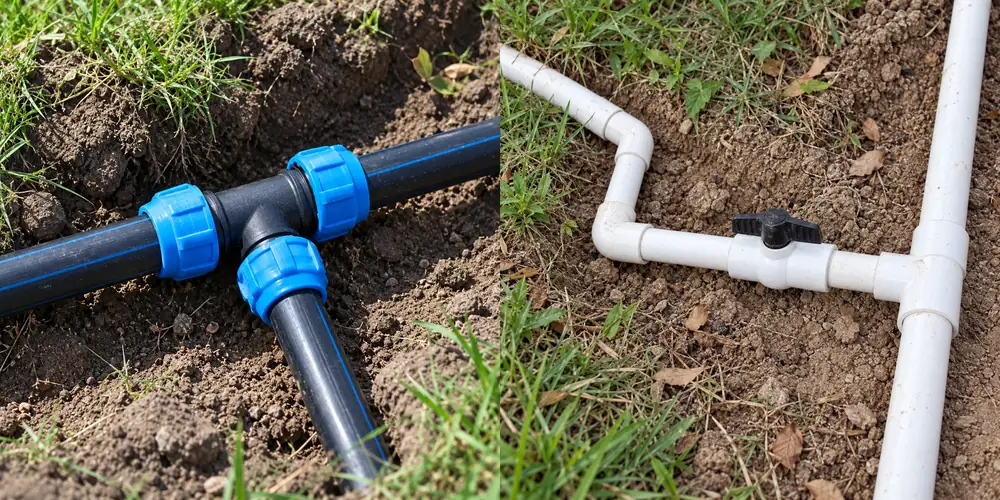
Key Performance Comparison: HDPE vs PVC for Irrigation Mains
| Factor | HDPE (PE100 / PE100-RC) | PVC (uPVC) | Practical Impact for Main Pipes |
| Joint integrity / Leak risk | Butt fusion or electrofusion creates a monolithic, leak-free pipeline | Solvent cement or gasket joints; potential weak points over time | HDPE greatly reduces water loss and maintenance on long pressure mains |
| Service life | 50+ years under normal buried conditions | Typically 20–40 years | Fewer replacements and lower lifetime cost with HDPE |
| Flexibility & soil movement | High flexibility; absorbs settlement, freeze-thaw, and minor ground shift | Rigid; sensitive to settlement, rocks, or poor bedding | HDPE performs better in uneven, expansive, or backfilled soils |
| Impact & cold resistance | Excellent toughness down to low temperatures; resists cracking | Becomes brittle in cold weather; more prone to impact damage | Safer in regions with frost or heavy machinery traffic |
| UV & chemical resistance | Carbon-black stabilized; excellent resistance to fertilizers, pesticides, and saline water | Moderate UV resistance (needs protection if exposed); good chemical resistance but more limited with some agrochemicals | HDPE preferred for fertigation and above-ground or partially exposed sections |
| Pressure capability | Reliable PN10–PN16 (and higher) ratings with appropriate SDR | Strong pressure performance, especially in rigid installations | Both suitable for typical irrigation pressures; HDPE often has larger internal diameter at same pressure class |
| Installation | Requires fusion equipment and trained crews; longer coil lengths mean fewer joints | Fast solvent welding or gasket joints with simple tools | PVC can be quicker for small crews; HDPE reliability compensates on larger projects |
| Maintenance | Very low; joints are as strong as the pipe | Higher risk of joint issues over decades | HDPE reduces downtime and repair costs |
Detailed Breakdown of the Most Important Factors
1. Leak resistance – the highest priority for mainlines
Fusion-welded HDPE joints form a continuous pipe. There are no gaskets to age or solvent joints that can fail under pressure cycles or ground movement. In fertigation systems this is critical: every leak wastes both water and expensive fertilizer. PVC joints, while reliable when new and properly made, introduce more potential leak points over a multi-decade service life.
2. Total cost of ownership, not just purchase price
PVC pipe is often 15–30% less expensive per meter at equivalent pressure ratings. However, when installation quality, joint reliability, repair frequency, and replacement cycles are included, HDPE frequently shows lower 20-year cost—especially on larger or more demanding projects. Water savings alone from reduced leakage can offset the initial premium.
3. Terrain, soil, and climate adaptability
HDPE’s flexibility allows it to follow uneven ground, tolerate minor settlement, and resist freeze-thaw expansion. It is the clearer choice for hilly land, areas with expansive or backfilled soils, regions with frost, or sites where agricultural machinery may cross the pipeline. Rigid PVC performs best on stable, flat ground with carefully prepared trenches and bedding.
4. Durability under real farm conditions
HDPE resists impact during installation and later farm operations, maintains toughness in cold weather, and handles the chemicals commonly used in modern irrigation. Black HDPE with proper carbon-black content also offers strong UV resistance if any sections are temporarily exposed.
When to Choose HDPE vs When PVC Can Still Work
Choose HDPE main pipe when:
- The mainline is long-distance or serves a large area
- Terrain is uneven, soils are unstable, or frost is possible
- The system includes fertigation or chemical injection
- You want 50-year design life with minimal maintenance
- High reliability and low water loss are priorities
- Future expansion or tapping may be needed
PVC can still be considered when:
- The mainline is short, low-pressure, and on flat, stable ground
- Initial budget is extremely constrained
- The installation crew has limited access to fusion equipment
- The project is temporary or has a short expected life
Many successful large projects use a hybrid approach: HDPE for the critical main trunk lines and PVC or PE for lower-pressure distribution laterals. This balances performance and cost.
Practical Selection Checklist
Before finalizing material, confirm:
- Operating pressure and required PN / SDR rating
- Total length of the mainline and elevation changes
- Soil type, risk of settlement, and frost depth
- Whether fertigation or aggressive water chemistry is involved
- Available installation equipment and crew skill level
- Target service life and acceptable maintenance frequency
- Local standards and any project specifications
Proper installation is as important as material choice. For HDPE this means correct fusion parameters, trained operators, and adequate trench bedding. For PVC it means careful joint preparation, proper solvent application, and support against movement.
Frequently Asked Questions
Is HDPE always better than PVC for irrigation mains?
For most permanent, pressure mainline applications, yes—particularly where leakage, longevity, and soil conditions matter. PVC remains competitive on simple, budget-driven, short runs.
How much more does HDPE cost upfront?
Typically 15–30% higher material cost, plus fusion equipment if not already available. The gap often narrows or reverses when lifetime water savings and reduced repairs are calculated.
Can HDPE handle the pressure of large irrigation pumps?
Yes. PE100 pipe is routinely specified for PN10, PN12.5, and PN16 (and higher) ratings commonly used in agricultural mains. Correct SDR selection is essential.
Is HDPE suitable for water-fertilizer integration systems?
Yes. Its chemical resistance and leak-free joints make it particularly well suited to fertigation mainlines.
What about installation speed?
PVC is usually faster for small teams without specialized tools. On larger projects the fewer joints and long coil lengths of HDPE often result in competitive overall installation times once fusion crews are organized.
Final Recommendation
For farmland irrigation main pipes that must perform reliably for decades with minimal water loss and low maintenance, HDPE is the stronger long-term choice. PVC can serve adequately in limited, low-risk applications, but the majority of modern professional irrigation designs favor HDPE for the critical mainline.
If you are planning a new irrigation mainline or upgrading an existing system, provide your project details (flow rate, pressure, length, terrain, and location). We can recommend the appropriate PE100 pipe size, SDR, and fittings and supply a clear quotation.
Puhui Industry manufactures both HDPE and PVC pipe systems and has extensive experience supplying irrigation projects worldwide. Contact us through phhdpepipe.com for technical support, product data, or a project-specific recommendation.